Richard Stevens

Physics of Fluids

University of Twente

Professor of Fluid Mechanics · University of Twente

Richard J.A.M. Stevens

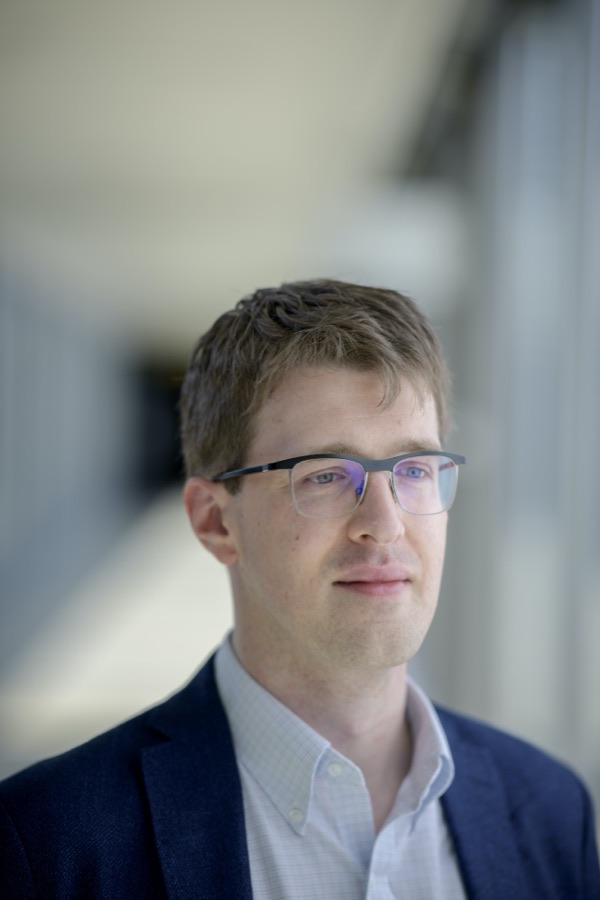
Portrait of Richard J.A.M. Stevens

I study how atmospheric turbulence shapes wind-farm flows — and how large wind farms, in turn, modify the atmosphere. My group in the Physics of Fluids at the University of Twente combines large-eddy simulation, direct numerical simulation, physical modelling, and high-performance computing to connect turbine-scale wakes, farm-scale flow organisation, and time-dependent atmospheric conditions, working to improve the prediction and design of wind-energy systems.

Explore the research →  ·  Selected publications →

Research programme

Turbulence links nearly every scale relevant to wind energy, from the flow immediately behind a single turbine blade to the atmospheric motions that drive a wind farm's day-to-day power output. My group's work sits across three connected areas: how wind farms and the atmosphere interact, how that interaction can be predicted without the cost of full simulation, and the canonical turbulence problems and computational tools that underpin both.

Wind-farm–atmosphere interaction

Wind farms operate inside a constantly changing atmospheric boundary layer: stability, wind shear, low-level jets, and large-scale pressure gradients all shape the inflow a turbine actually experiences. My group uses large-eddy simulation to study how these atmospheric conditions set turbine wake recovery, farm-scale power output, and structural loading — and, in the other direction, how large wind farms feed back on the boundary layer around them, including their effect on nearby clouds and the atmosphere's heat and moisture exchange. Read more about wind-farm flow physics and atmospheric boundary layers.

Multiscale prediction and physical modelling

Full large-eddy simulations of a wind farm under realistic, time-varying weather are still far too expensive to run for every design question. My group develops physics-based and reduced-order models — building on the coupled wake–boundary-layer approach — that connect wake dynamics, boundary-layer theory, and time-dependent atmospheric forcing to wind-farm performance at a fraction of the computational cost, making it possible to explore far more layouts, sites, and atmospheric scenarios than simulation alone allows. Read more about analytical wind-farm modelling.

Turbulence simulation and HPC

Canonical turbulence problems — Rayleigh-Bénard convection, Taylor-Couette flow, and other wall-bounded systems — are simpler than a real wind farm, but they let us isolate the physical mechanisms and test the numerical methods that the group's larger atmospheric and wind-farm simulations depend on. These direct numerical simulations run on national and international supercomputing facilities, using AFiD, my group's open-source direct numerical simulation code. Read more about canonical turbulence research and AFiD.

Selected contributions

How does wake recovery change from a single turbine to a full wind farm?

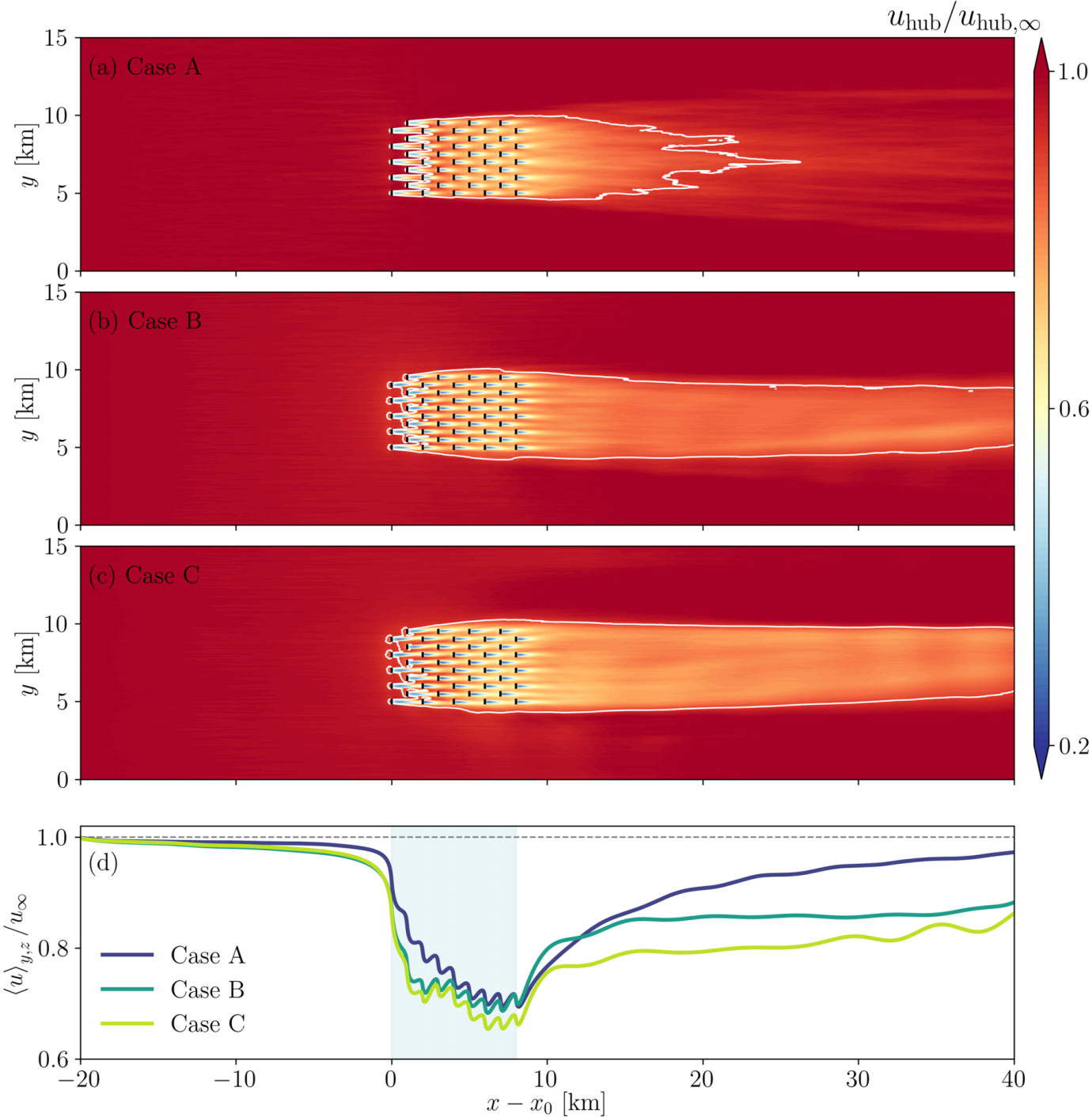
Wake-recovery models developed for an isolated turbine do not simply scale up to a large wind farm — the physical mechanism that governs recovery shifts as more turbines are added. This paper identifies how that transition develops in the modeled deep conventionally neutral boundary layer. For sufficiently large arrays, including the studied farms of at least 3 x 3 turbines, vertical turbulent transport and mechanical-energy fluxes become the main channels replenishing the farm wake. J.H. Kasper, R.J.A.M. Stevens, J. Renew. Sustain. Energy 18, 013302 (2026). Featured article, Journal of Renewable and Sustainable Energy.

Why does wind-farm power fluctuate across so many different timescales?

Wind-farm power output varies from turbulence-driven fluctuations lasting seconds to weather-driven swings lasting hours. This paper develops a physics-based model connecting these multiscale atmospheric interactions to the shape of the wind-farm power spectrum, linking short-timescale turbulence to longer-timescale atmospheric variability in a single framework. Y. Liu, R.J.A.M. Stevens, PRX Energy 5, 023012 (2026).

How does a wind farm respond when the pressure gradient changes with height?

Most wind-farm simulations assume a pressure gradient that stays constant with height. Real atmospheric boundary layers are frequently baroclinic — the pressure gradient, and therefore the wind, rotates with height — and this paper examines how that baroclinicity changes wind-farm flow and power output compared with the simpler, conventionally neutral case usually assumed. J.H. Kasper, A. Stieren, R.J.A.M. Stevens, J. Renew. Sustain. Energy 16(6), 063302 (2024). Featured article, Journal of Renewable and Sustainable Energy.

How do low-level clouds change wind-farm wake recovery?

Longwave cooling at the top of a stratocumulus cloud layer strengthens turbulent entrainment and deepens the atmospheric boundary layer. The resulting downward transport brings more momentum and energy from the stronger winds above toward the turbines, accelerating far-wake recovery behind the wind farm. D. Selvatici, R.J.A.M. Stevens, PRX Energy (accepted, 2026).

WINDFLOW

WINDFLOW is my ERC Consolidator Grant project, awarded in 2023, which develops large-eddy simulation strategies that couple directly to large-scale weather models. Wind-farm simulations conventionally assume idealized, steady inflow; WINDFLOW instead asks how wind farms perform under real, time-evolving weather, and how they in turn affect atmospheric stability, moisture, and the exchange of energy between the atmosphere and the ocean — insights needed to design the next generation of offshore wind farms.

Methods and computational capability

My group combines four complementary methods. Large-eddy simulation (LES) resolves atmospheric and wind-farm flows across large domains and time-dependent forcing, where direct simulation of every turbulent scale is not feasible. Direct numerical simulation (DNS) resolves every scale in smaller, canonical systems, providing reference data and isolating physical mechanisms without a turbulence model. Physical and analytical modelling turns these results into mechanistic, reduced-order predictions that stay tractable across the many scenarios engineering applications require. High-performance computing underlies all of it: our simulations run on national and international supercomputing facilities and can contain up to billions of computational cells. Much of this work uses AFiD, our open-source direct numerical simulation code for canonical turbulent flows such as Rayleigh-Bénard convection, Taylor-Couette flow, and channel flow.

Group and opportunities

My group currently includes postdocs and PhD students working across these research areas, alongside several completed PhDs and postdocs now at other institutions. It is embedded in the Physics of Fluids group at the University of Twente and the Max Planck Center Twente, and collaborates with universities, research institutes, and industrial partners in fluid mechanics, atmospheric science, wind-energy engineering, and scientific computing. Meet the group, or see student projects and vacancy status for PhD and postdoc positions.

Contact

Richard J.A.M. Stevens — Professor of Fluid Mechanics
Physics of Fluids group
Faculty of Science and Technology
University of Twente
Building Meander
P.O. Box 217
7500 AE Enschede
The Netherlands
T: +31 (0)53 489 5359
E: r.j.a.m.stevens@utwente.nl
ORCID: 0000-0001-6976-5704  ·  Scholar: Google Scholar profile