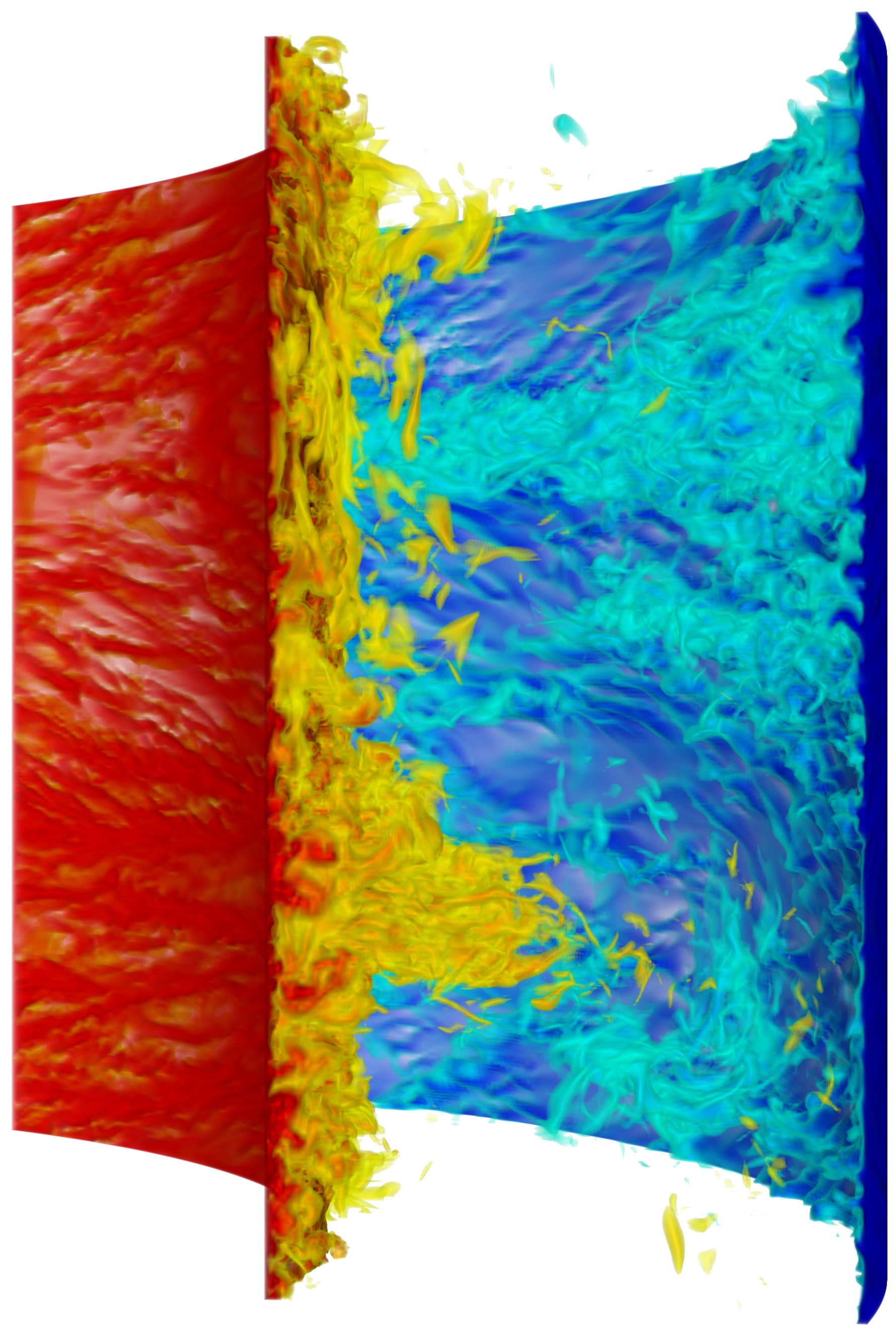
AFiD and AFiD-GPU turbulence simulation
AFiD is an open-source Navier–Stokes solver for wall-bounded turbulence. With the international solver team, I co-developed AFiD-GPU for large parallel simulations of canonical turbulent flows.
The collaboration includes the University of Twente, University of Rome “Tor Vergata”, SURFsara and NVIDIA. The solver family supports canonical convection and shear flows; consult each repository for supported configurations.
Convection studies using direct numerical simulation
Technical and reproducibility overview
Numerical method
AFiD solves the incompressible Navier–Stokes equations, with an additional temperature or scalar equation where required, in Cartesian or cylindrical coordinates. The published CPU method uses conservative second-order centred finite differences on a staggered grid, MPI, and a two-dimensional pencil domain decomposition.
Builds and configurations
The CPU repository documents MPI, BLAS, LAPACK, FFTW3, and parallel HDF5 prerequisites and provides a manual and example inputs. The GPU implementation uses CUDA Fortran and supplies CPU, GPU, and experimental hybrid builds. Its machine-specific instructions are historical and must be adapted and tested on current systems.
Using or extending AFiD. For a scientific collaboration, email Richard Stevens with the flow configuration, parameter regime, target observables, intended hardware, and the repository commit you have tested. The public repositories are research code; the cited papers and case-specific checks, rather than repository availability alone, establish numerical evidence.
When using the GPU version, please cite:
X. Zhu, E. Phillips, V. Spandan, J. Donners, G. Ruetsch, J. Romero, R. Ostilla-Mónico, Y. Yang, D. Lohse, R. Verzicco, M. Fatica, R.J.A.M. Stevens, AFiD-GPU: A versatile Navier–Stokes solver for wall-bounded turbulent flows on GPU clusters, Comput. Phys. Commun. 229, 199-210 (2018).
When using the CPU version, please cite:
E.P. van der Poel, R. Ostilla-Mónico, J. Donners, R. Verzicco, A pencil distributed finite difference code for strongly turbulent wall-bounded flows, Computers & Fluids 116, 10-16 (2015).
The images below were generated from simulations performed with AFiD.
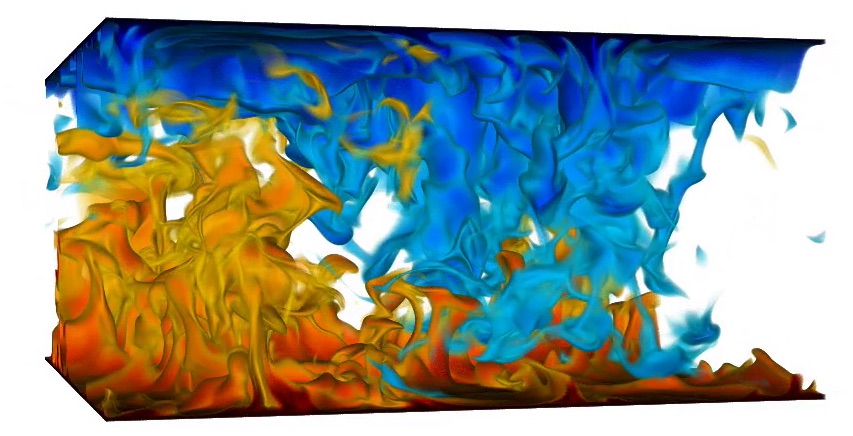
Rayleigh-Bénard convection
For corresponding video look at the Physics of Fluids YouTube channel. Further information is available on the thermal convection research page.
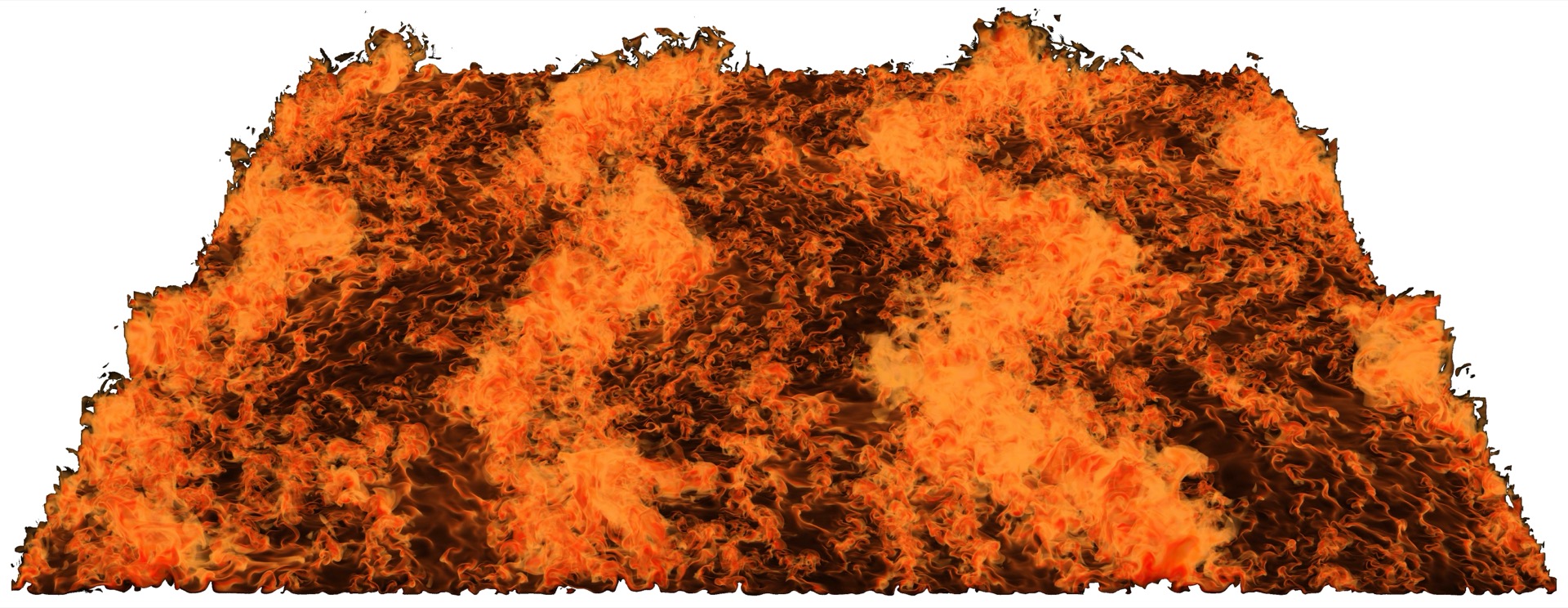
Sheared convection
For corresponding video look at the Physics of Fluids YouTube channel.
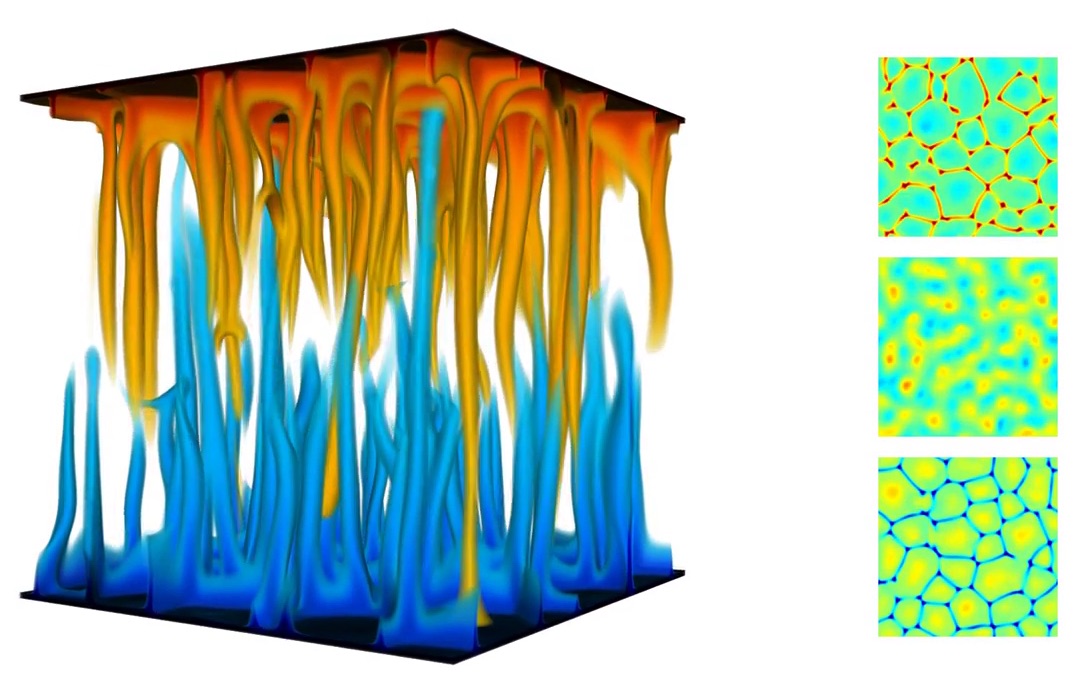
Double diffusive convection
For corresponding video look at the Physics of Fluids YouTube channel.
Taylor-Couette flow