Publication 86 · Atmospheric turbulence
How stratification and rotation organize boundary-layer height
L. Liu, S.N. Gadde, and R.J.A.M. Stevens, Quarterly Journal of the Royal Meteorological Society 147(735), 847-857 (2021).
Read the article Open-access version
The article and Figure 4 are open access under CC BY 4.0.
Main finding
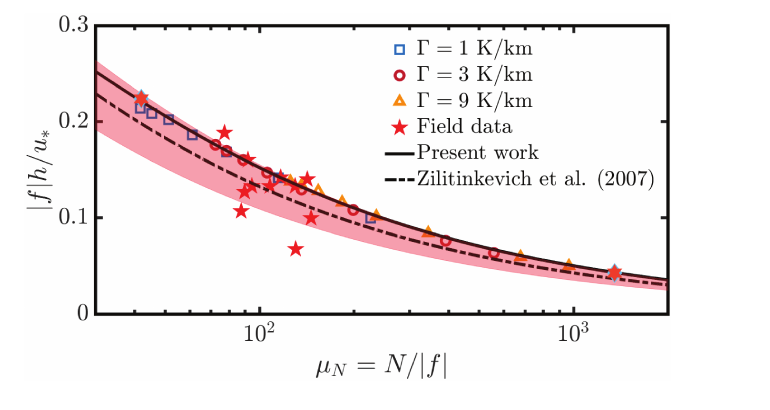
Across 24 idealized conventionally neutral atmospheric-boundary-layer LES, the dimensionless 5%-momentum-flux height |f|h/u* decreased systematically as the stratification-to-rotation ratio N/|f| increased from 42 to 1350. A curve fitted within the same simulation campaign organized the cases, while selected field estimates showed broad consistency rather than independent validation.
Why this matters
A zero surface heat flux does not make an inversion-capped atmospheric boundary layer dynamically identical to a truly neutral layer. Free-atmosphere stratification limits the layer from above while planetary rotation sets a competing time and length scale. Their ratio therefore provides a physically motivated coordinate for organizing the layer height and, in the wider paper, the empirical coefficients entering the geostrophic drag law.
Research context
The main campaign contains 24 wall-modelled LES in a flat, horizontally periodic 2π km × 2π km × 2 km domain. It fixes the geostrophic wind at 12 m s−1 and roughness length at 10−4 m while varying latitude from 5° to 70° and free-atmosphere lapse rate from 1 to 9 K km−1. The simulations use a traditional f-plane, zero surface heat flux, uniform geostrophic wind, and no baroclinicity, terrain, roughness heterogeneity, or transient forcing. The height and drag-law curves are calibrated on the same LES matrix; no fit covariance or held-out numerical test is supplied. Endpoint grid and subgrid-model checks preserve the main trend but do not establish absolute convergence, and the selected field data do not control measurement uncertainty, roughness, nonstationarity, or thermal-state differences. The result is therefore a regime-specific empirical organization, not a universal boundary-layer-height law or a direct wind-energy-performance prediction.
View in the complete publication list Related boundary-layer research