Publication 99 · Wind-farm flow
Analytical model of fully developed wind farms in conventionally neutral atmospheric boundary layers
C. Li, L. Liu, X. Lu, R.J.A.M. Stevens, J. Fluid Mech. 948, A43 (2022).
Read the article Open-access version
Main finding
Boundary-layer height defined where total stress falls to 5% of its surface value follows a CNBL scaling with fitted constant near 1.61; inversion height is about 0.9h with corresponding constant near 1.45. Geostrophic drag-law coefficients depend on stability parameter but differ from flat-terrain values because wind-farm drag is larger.
Why this matters
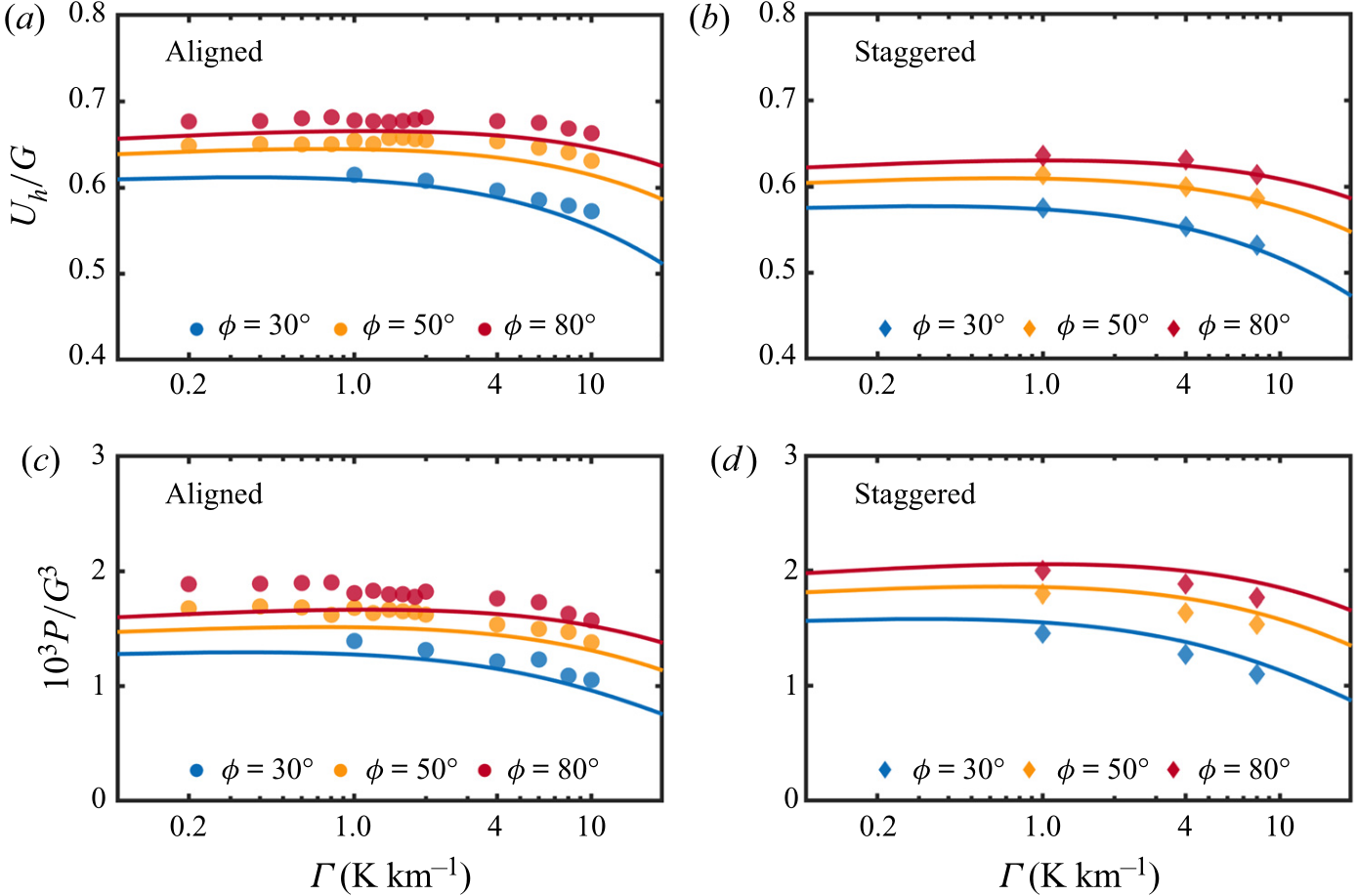
Supports a conditional CNBL system optimum and demonstrates that atmospheric depth/rotation enter farm power.
Research context
The joined model closes the momentum pathway from geostrophic forcing through boundary-layer drag to the turbine layer. Its constants are calibrated and assessed on the same LES family, one spacing, and two layouts.
View in the complete publication list Related wind-farm research