Publication 43 · Wind-farm flow
Characterizing the coherent structures in large eddy simulations of aligned windfarms
M. Zhang, R.J.A.M. Stevens, J. Phys.: Conf. Ser. 854, 012052 (2017).
Read the article Open-access version
Main finding
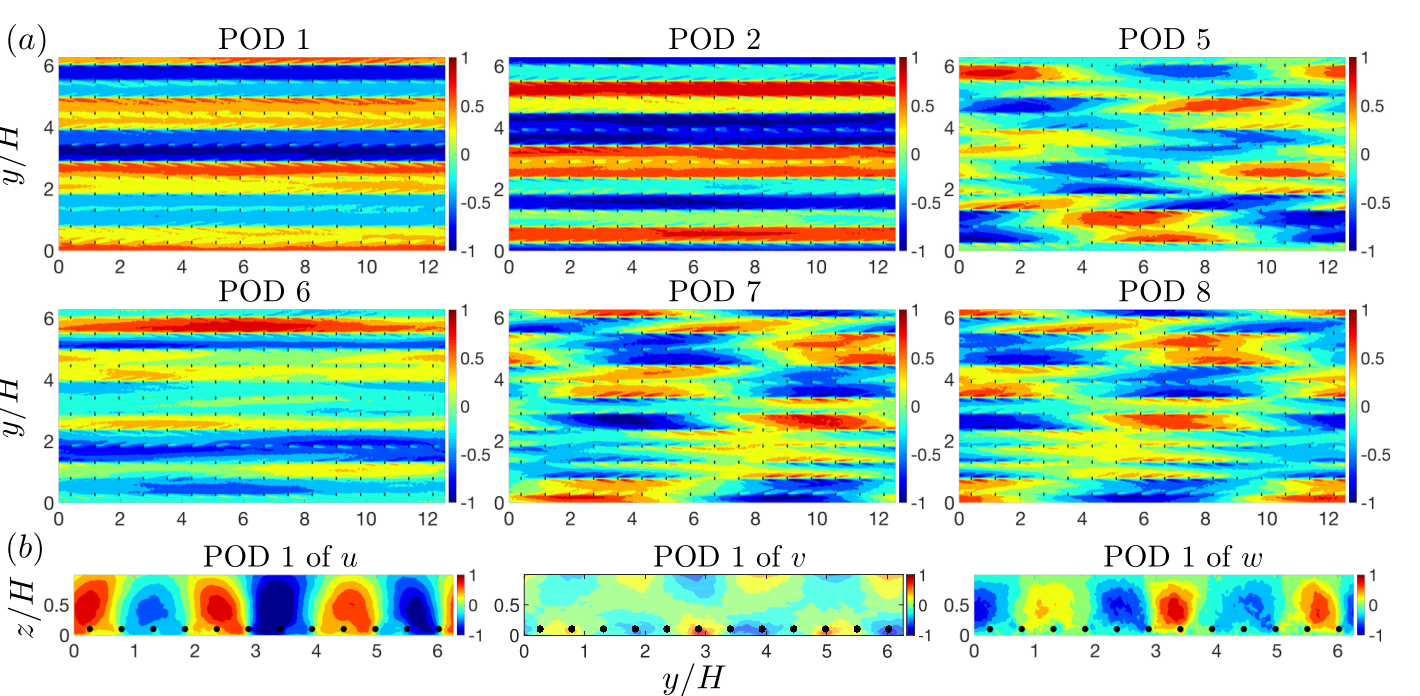
Aligned turbine rows organize large atmospheric motions into roll-like leading POD structures in the tested LES. Their modal ordering does not establish a causal energy-transfer pathway, low-dimensional dominance or general farm-control mechanism.
Why this matters
Large atmospheric motions become spatially organized around turbine rows.
Research context
The concurrent-precursor method supplies turbulent inflow, while coupled wake–boundary-layer models frame the multiscale setting. Proper orthogonal decomposition ranks coherent energetic structures in the aligned farm; later energy-budget work diagnoses resolved transfer mechanisms rather than inferring them from modal rank.
View in the complete publication list Related wind-farm research