Publication 34 · Wind-farm flow
Using the coupled wake boundary layer model to evaluate the effect of turbulence intensity on wind-farm performance
R.J.A.M. Stevens, D.F. Gayme, C. Meneveau, J. Phys.: Conf. Ser. 625, 012004 (2015).
Read the article Open-access version
Main finding
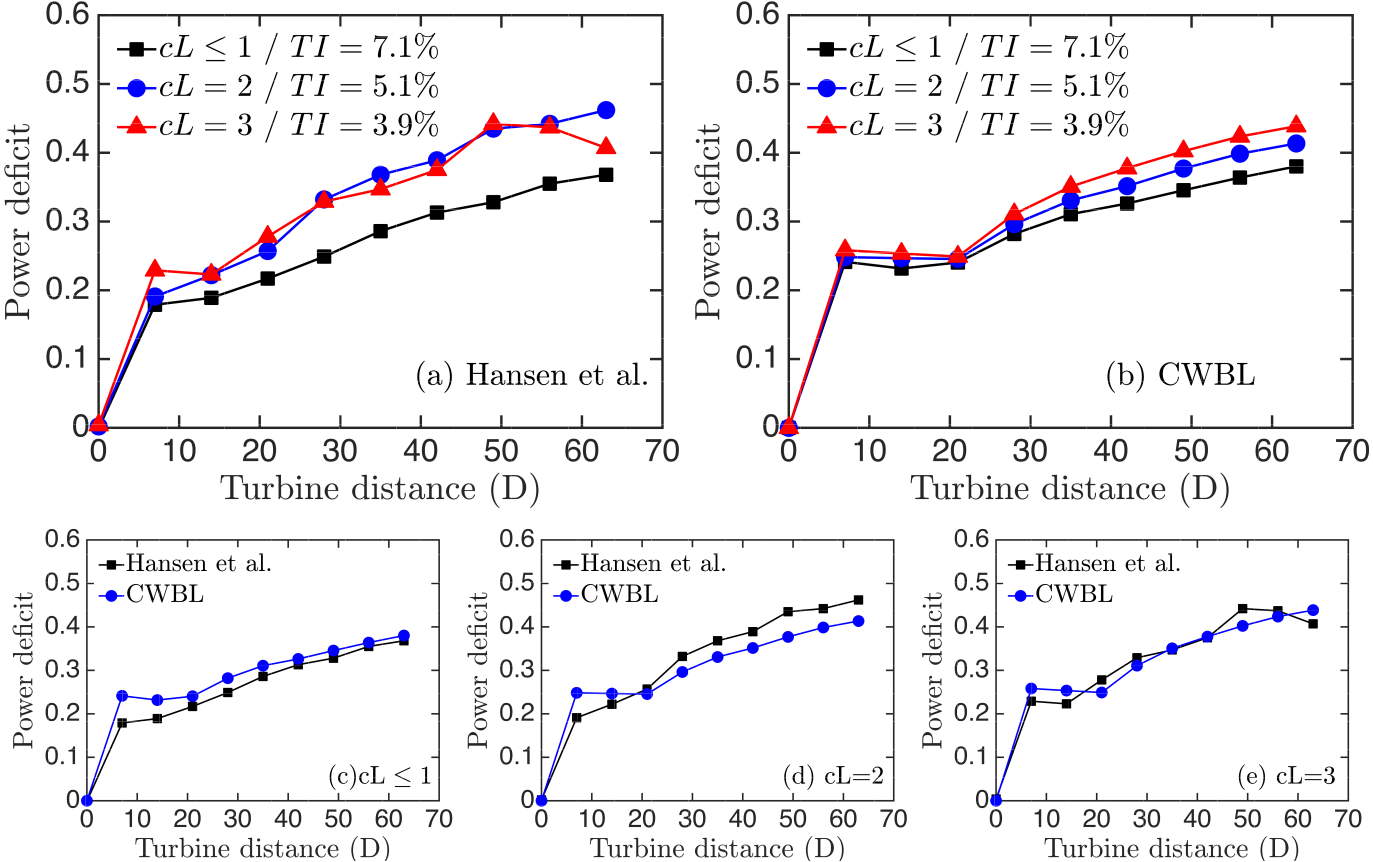
The generalized CWBL predicts lower wake deficits with higher ambient TI and greater sensitivity in downstream rows. Model trends compare reasonably with Horns Rev and the selected LES case, but direction-dependent field behavior is stronger in two sectors and the discrepancy is unresolved.
Why this matters
Supports the conditional statement that higher modeled ambient TI weakens downstream deficits.
Research context
Higher ambient turbulence accelerates wake expansion in the coupled model. Atmospheric stability can also change shear, veer, boundary-layer height, mixing length, and turbine-scale transport, so turbulence intensity alone is not causally sufficient.
View in the complete publication list Related wind-farm research