Publication 108 · Cross-cutting research
Effect of airflow rate on CO2 concentration in downflow indoor ventilation
G.S. Yerragolam, C.J. Howland, R. Yang, R.J.A.M. Stevens, R. Verzicco, D. Lohse, Indoor Environments 1(2), 100012 (2024).
Main finding
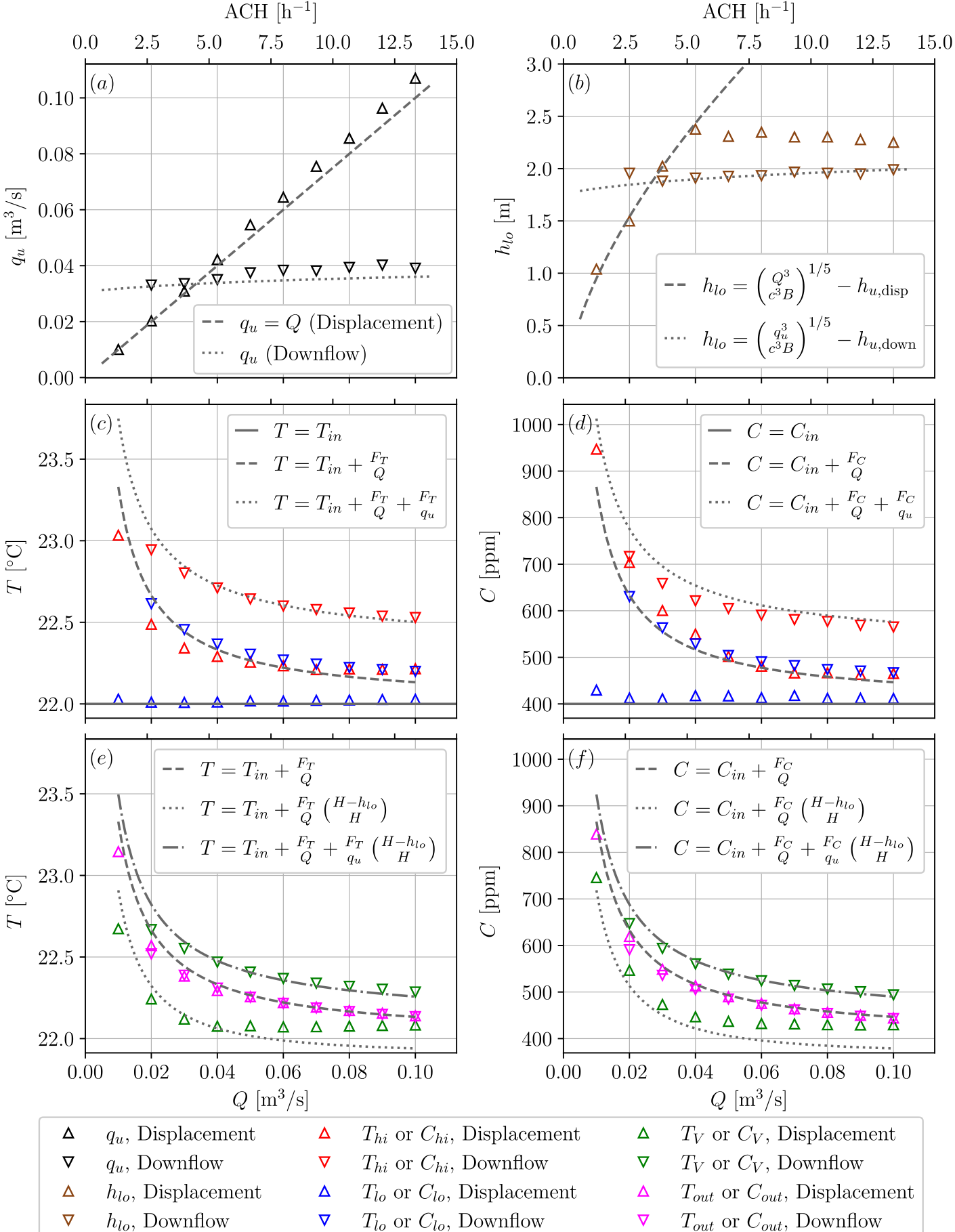
Ventilation layout and mixing change how lower-layer, volume-average and outlet CO2 concentrations relate in the sampled cases. Absolute CO2 decreases as airflow increases in Equation (4) and Figure 4; no infection-risk conclusion is supported.
Why this matters
More mixing does not automatically mean a cleaner breathing zone.
Research context
Occupant and inlet plumes establish two scalar layers. Downflow ventilation recirculates upper-layer contaminant downward, whereas displacement ventilation replaces the lower layer with clean supply air; the model does not extend to infection dose or a multi-occupant non-adiabatic room.