Publication 59 · Atmospheric turbulence
Effect of Coriolis force on a wind farm wake
S. Nagarada Gadde, R.J.A.M. Stevens, J. Phys. Conf. Ser. 1256, 012026 (2019).
Main finding
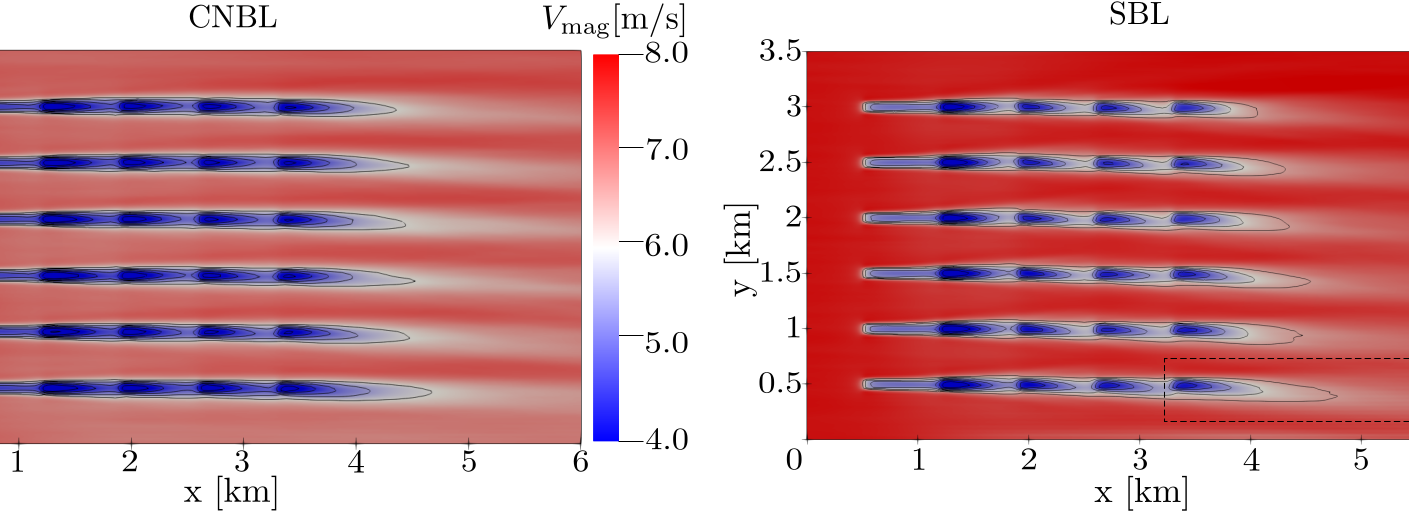
Figure 2 reports wind-direction change across the rotor of about 6.4 deg in the CNBL and 15.2 deg in the SBL. Figure 3 shows the wind-farm wake turning anticlockwise near the entrance and clockwise farther downstream, with the stronger and more persistent deflection in the SBL.
Why this matters
The useful concept is that wake direction changes with height-dependent momentum transport in a rotating boundary layer.
Research context
The cases correlate stability, wind veer, vertical momentum-flux gradients, and wake rotation. The reduced equations omit streamwise and lateral inhomogeneity, pressure perturbations, transient adjustment, and farm blockage, so they do not establish one primary causal pathway.
View in the complete publication list Related atmospheric boundary layer research