Publication 79 · Atmospheric turbulence
Effect of low-level jet on turbine aerodynamic blade loading using large-eddy simulations
S.N. Gadde, L. Liu, R.J.A.M. Stevens, J. Phys. Conf. Ser. 1934, 012001 (2021).
Read the article Open-access version
Main finding
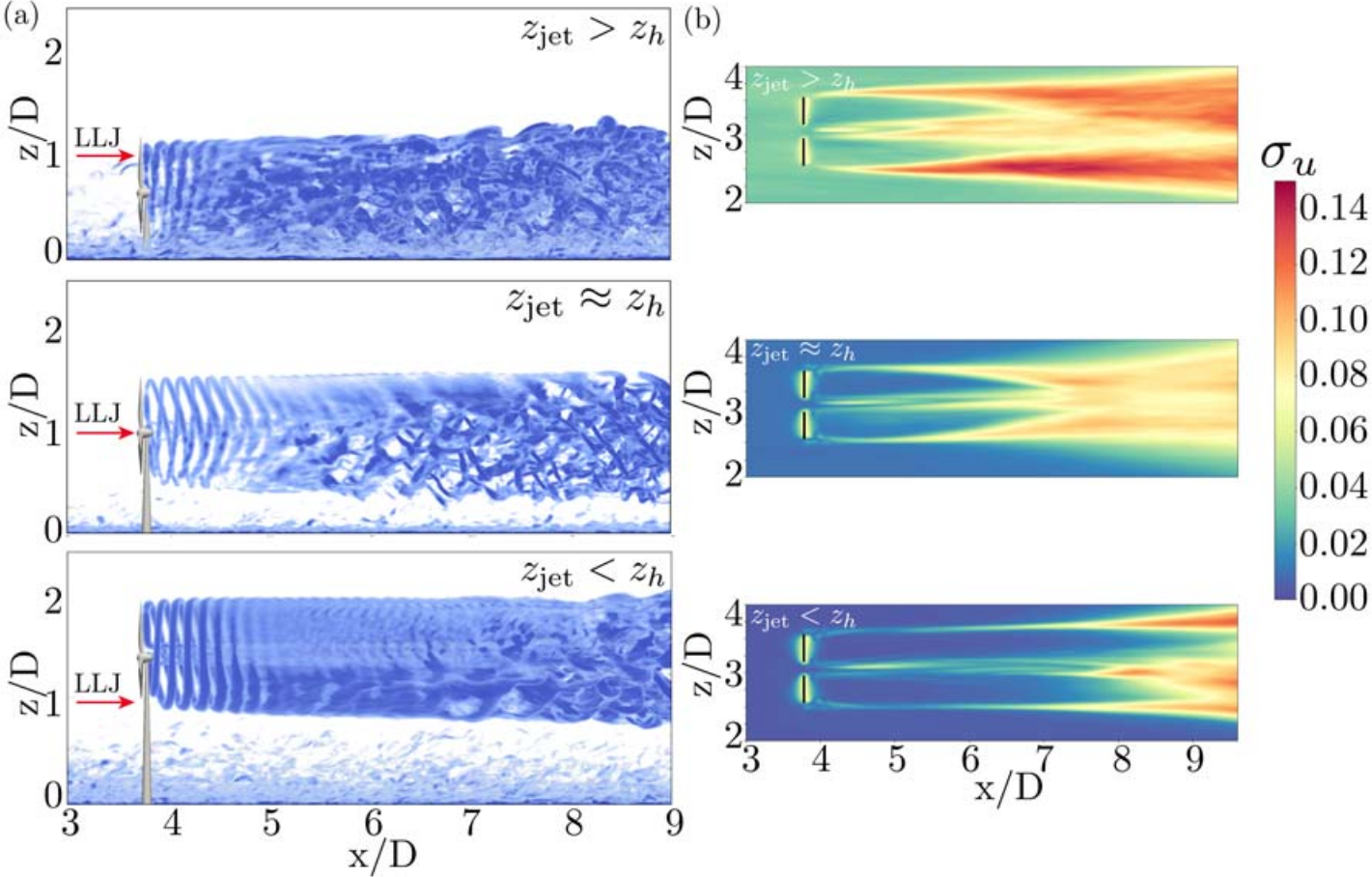
The study asks how LLJ position affects near-wake vortices and external aerodynamic blade forces for one NREL 5-MW turbine. Wall-modelled Boussinesq LES uses AMD, concurrent precursor inflow, and an actuator-line representation previously compared with wind-tunnel data. Two moderately stable boundary layers use G=9 m s^-1, f=1.159e-4 s^-1, roughness lengths 0.002/0.0002 m, and cooling rates 0.25 and 0.50 K h^-1.
Why this matters
It clearly shows that where a blade crosses a jet matters.
Research context
Low ambient turbulence above the jet preserves coherent near-wake vortices, while vertical velocity shear produces azimuthal force variation. The study computes external aerodynamic forces, not structural stress histories or lifetime fatigue damage.
View in the complete publication list Related atmospheric boundary layer research