Publication 83 · Atmospheric turbulence
Effects of atmospheric stability on the performance of a wind turbine located behind a three-dimensional hill
L. Liu, R.J.A.M. Stevens, Renewable Energy 175, 926-935 (2021).
Main finding
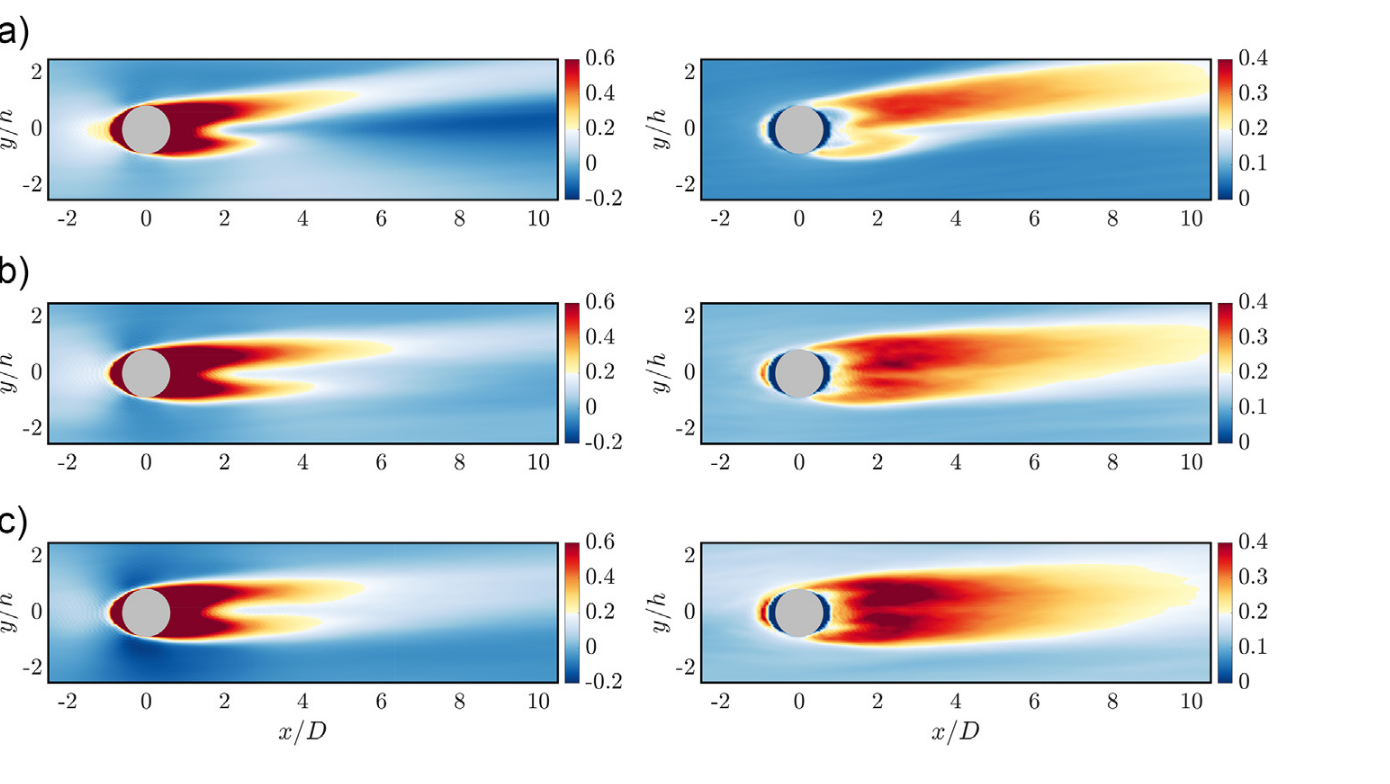
The study asks how stable, neutral, and convective atmospheric states change the power, aerodynamic-force variability, and wake of one NREL 5-MW turbine placed 6D behind a three-dimensional hill. Boussinesq LES uses a Lagrangian scale-dependent SGS model, immersed boundary terrain, and an actuator-line turbine (D=126 m) at fixed 9.1552 rpm; tower, nacelle, and controller dynamics are omitted. The cosine-squared hill has height h=90 m=z_h and half-length l=2.5h.
Why this matters
The clearest lesson is that veer can move a turbine into or out of a hill wake.
Research context
The three atmospheric states combine wake displacement by veer, hill-wake deficit, low-level-jet or high-momentum entrainment, and terrain-generated turbulence. They do not isolate atmospheric stability as a single causal variable.
Coverage of this research
- NEMO Kennislink — Verrassing: windmolens productiever achter een heuvel, . Dutch interview with Richard Stevens about the Liu–Stevens hill and atmospheric-stability study.
View in the complete publication list Related atmospheric boundary layer research