Publication 73 · Atmospheric turbulence
Effects of Two-Dimensional Steep Hills on the Performance of Wind Turbines and Wind Farms
L. Liu, R.J.A.M. Stevens, Bound.-Layer Meteorol 176, 251–269 (2020).
Read the article Open-access version
Main finding
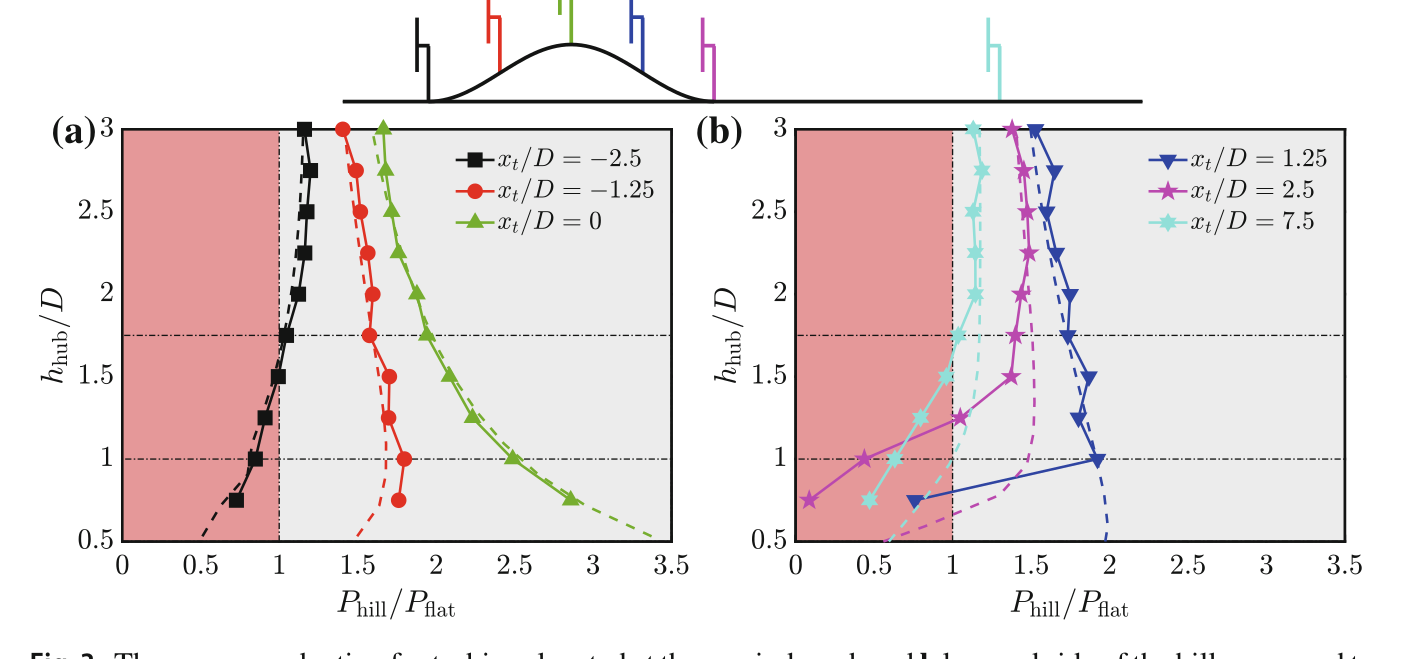
The paper asks how an idealized steep two-dimensional hill changes power and wakes for a single turbine, an aligned or staggered farm, and a valley-confined farm. It uses truly neutral, pressure-driven wall-modelled LES with a Smagorinsky SGS model, an immersed-boundary hill, and filtered actuator disks (C_T=0.75, C_T'=4/3). Horizontal discretization is pseudo-spectral/periodic; vertical differencing is second order; concurrent precursor inflow is used.
Why this matters
It is useful for separating local speed-up from whole-farm performance.
Research context
The response combines hilltop acceleration, windward blockage, lee separation, terrain-following turbine wakes, pressure recovery, and terrain-generated transport. Enhanced vertical flux alone does not guarantee faster wake recovery.
View in the complete publication list Related atmospheric boundary layer research