Publication 110 · Wind-farm flow
Effects of wind turbine rotor tilt on large-scale wind farms
J.H. Kasper, R.J.A.M. Stevens, J. Phys. Conf. Ser., 2767, 092072 (2024).
Main finding
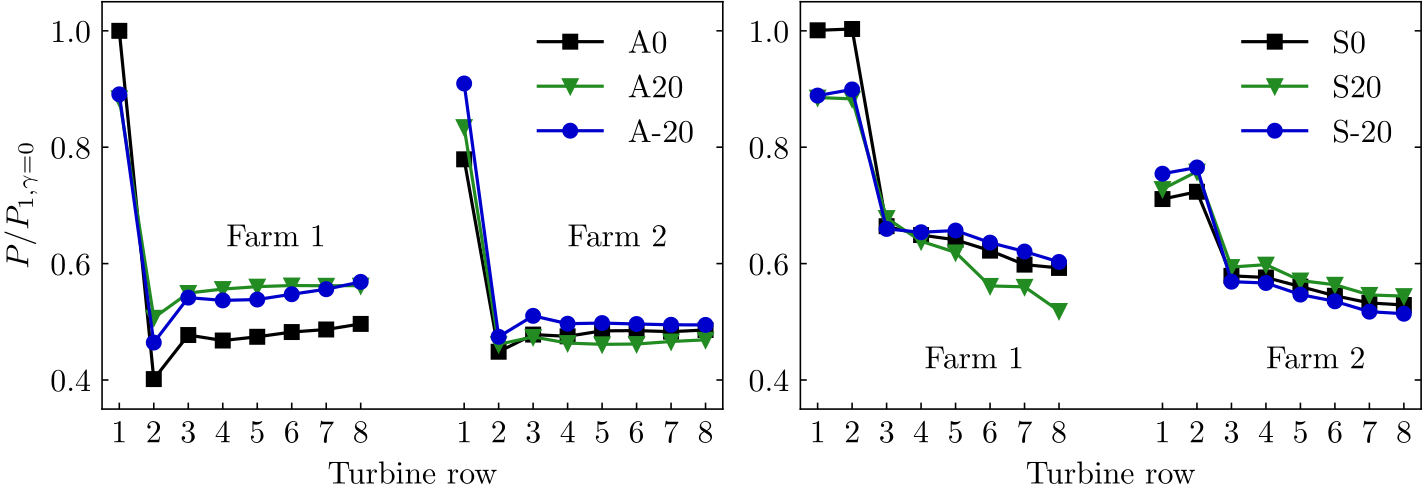
In the upstream aligned farm, uniform +20 and -20 degrees tilt raise total aerodynamic power by 11% and 8% relative to no tilt, despite roughly 10% first-row loss; downstream rows benefit from wake deflection. In the staggered upstream farm, both tilt signs reduce total performance because baseline direct-wake losses are already lower and deflection does not repay cosine/misalignment loss.
Why this matters
Supports strong layout dependence of tilt control and short-ranged upstream/downstream farm interaction.
Research context
Tilt changes rotor-normal extraction, vertical wake displacement, streamwise vortices, and farm-wake structure. Whether that repays the first-row misalignment loss depends on downstream rotor placement.
View in the complete publication list Related wind-farm research