Publication 78 · Wind-farm flow
Evaluating wind farm wakes in large eddy simulations and engineering models
A. Stieren, R.J.A.M. Stevens, J. Phys. Conf. Ser. 1934, 012018 (2021).
Main finding
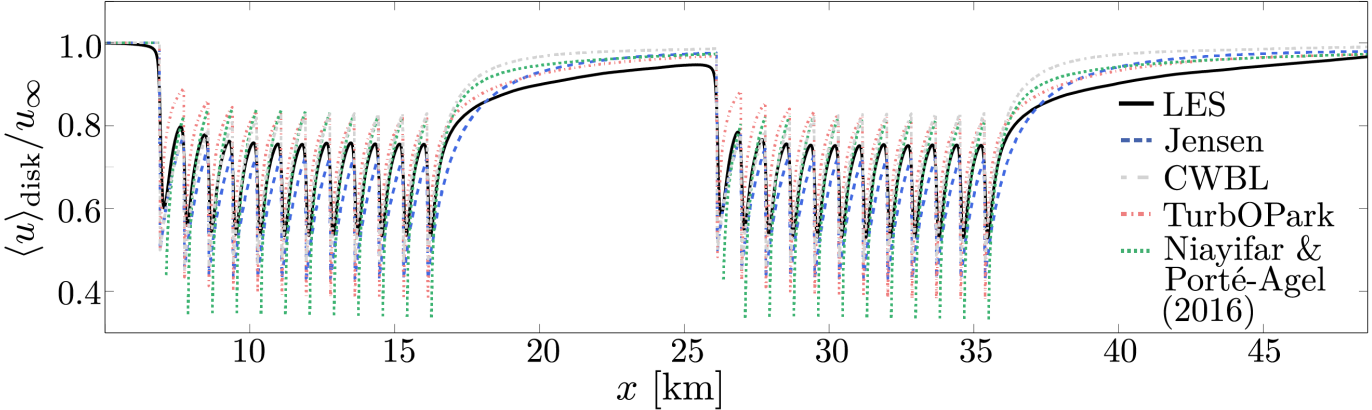
Common hub-height engineering implementations recover a farm wake too quickly in the tested comparison, even when within-farm power agrees reasonably with LES. Downstream-farm entrance power exposes that difference; the study is not a general model ranking or validation of complete TurbOPark.
Why this matters
A wake from one farm can lower the first-row output of another 10 km away.
Research context
The comparison places engineering wake models against concurrent-precursor LES for finite farms, exposing where simple wake superposition misses vertical momentum supply and entrance effects. Later finite-farm interaction, power-density, and energy-budget studies broaden the scale range and diagnose mechanisms not represented by those reduced models.
View in the complete publication list Related wind-farm research