Publication 119 · Wind-farm flow
Evolution and instability of the tip vortices behind a yawed wind turbine
C. Li, A.-K. Gao, L. Liu, X.-Y. Lu, R.J.A.M. Stevens, J. Fluid Mech., 1016, A20 (2025).
Read the article Open-access version (university repository)
Main finding
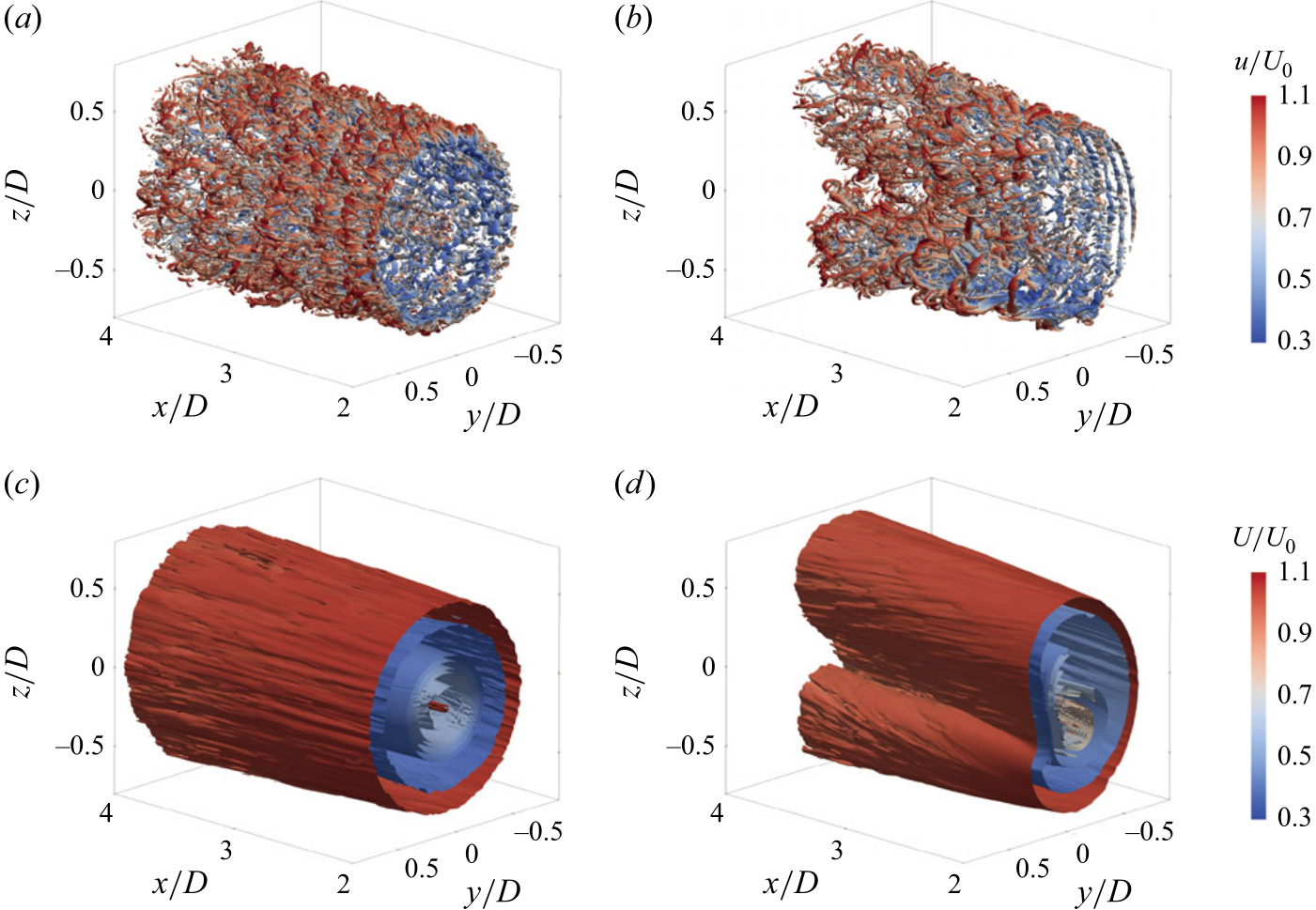
Yaw produces unequal tip-vortex circulation and asymmetric vortex evolution in the simulated turbine wake. The modal interpretation depends on the numerical model and does not independently establish a yaw-control mechanism.
Why this matters
Yaw makes neighboring tip vortices evolve asymmetrically through unequal circulation and mutual induction, affecting coherent wake development.
Research context
The study combines lessons from multi-code wake validation, actuator-line resolution, tip-corrected loading, and downstream wake-region mapping. Its high-resolution simulations resolve how yaw deforms and destabilizes tip vortices, while the analytical modal interpretation remains model dependent.
View in the complete publication list Related wind-farm research