Publication 51 · Wind-farm flow
Exploring a better turbine layout in vertically staggered wind farms
M. Zhang, R.J.A.M. Stevens, J. Phys. Conf. Ser. 1037, 072041 (2018).
Main finding
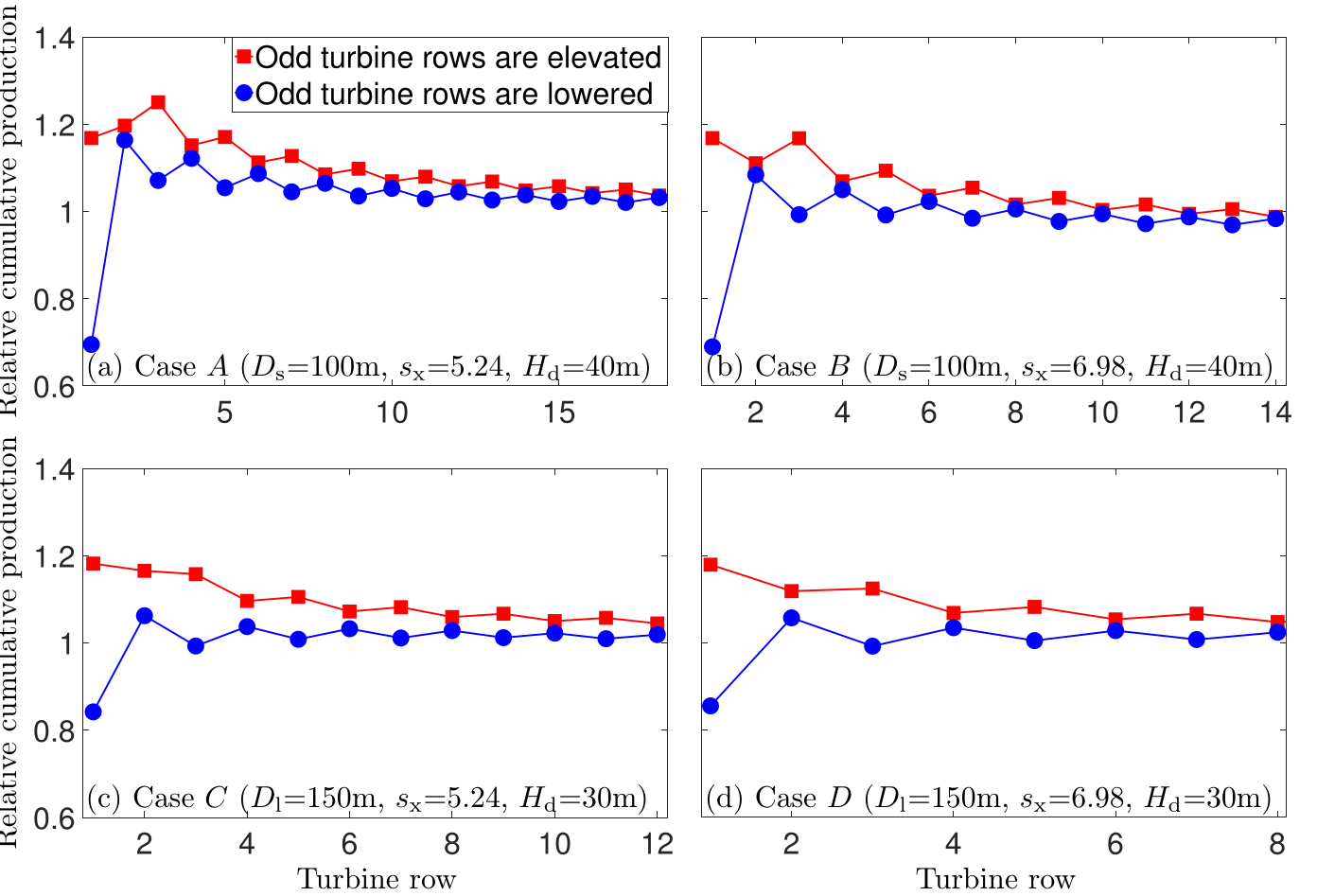
Elevating the first (odd) row yields higher entrance production than lowering it because the first row accesses faster undisturbed flow aloft. For the first four rows, odd-elevated layouts produce 1.069–1.152 times the aligned reference across cases; odd-lowered layouts produce 1.035–1.122.
Why this matters
Supports the bounded claim that ordering high and low rows matters mainly in the entrance region.
Research context
Elevating alternate entrance rows gives them access to faster undisturbed flow and avoids direct wake overlap. Farther downstream, vertical staggering does not change the momentum-replenishment constraint enough to sustain the gain.
View in the complete publication list Related wind-farm research