Publication 40 · Wind-farm flow
Generalized coupled wake boundary layer model
R.J.A.M. Stevens, D.F. Gayme, C. Meneveau, Wind Energy 19 (11), 2023-2040 (2016).
Read the article Open-access version (university repository)
Main finding
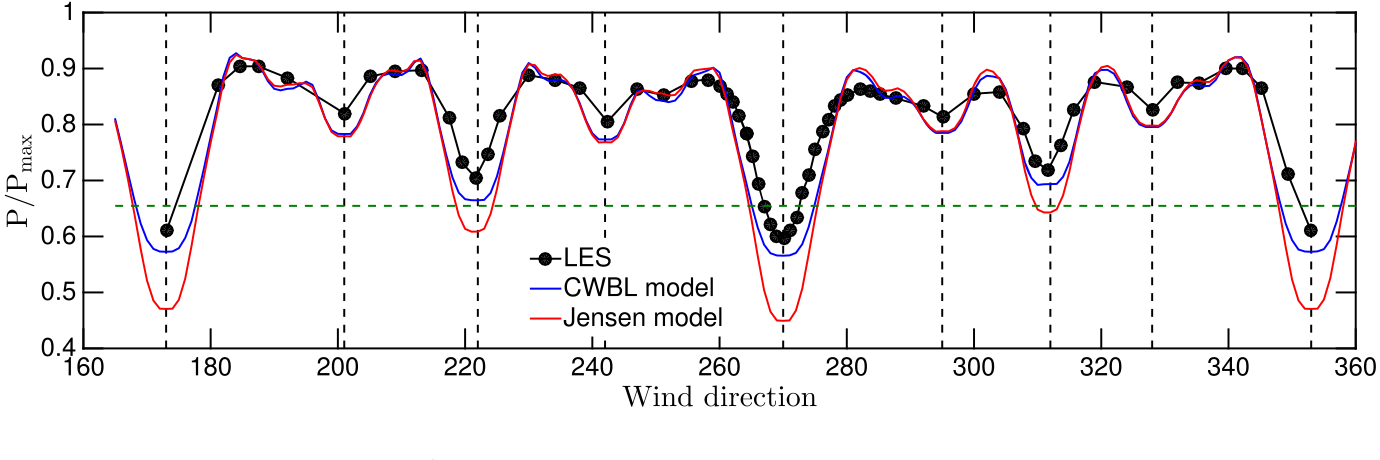
The generalized CWBL formulation replaces the original lattice-specific effective spacing with a direction-specific Jensen-derived wake-area fraction and reduces the reported RMS relative Horns Rev LES total-power discrepancy from 9.5% for Jensen to 6.3% for CWBL. This supports a useful deep-array correction for the tested neutral steady direction sweep, but neither uniquely validates w_f or k_w,∞ nor establishes general operational wind-farm skill.
Why this matters
Why a farm-scale atmospheric model can correct a turbine-by-turbine wake model downstream.
Research context
The generalized model replaces lattice-specific spacing with a direction-dependent wake-area measure while retaining the top-down momentum closure. Later LES comparisons, power-density analyses, and energy budgets test farm behavior that this steady reduced-order framework cannot resolve directly.
View in the complete publication list Related wind-farm research