Publication 81 · Atmospheric turbulence
Interaction between low-level jets and wind farms in a stable atmospheric boundary layer
S.N. Gadde, R.J.A.M. Stevens, Phys. Rev. Fluids 6, 014603 (2021).
Read the article Open-access version
Main finding
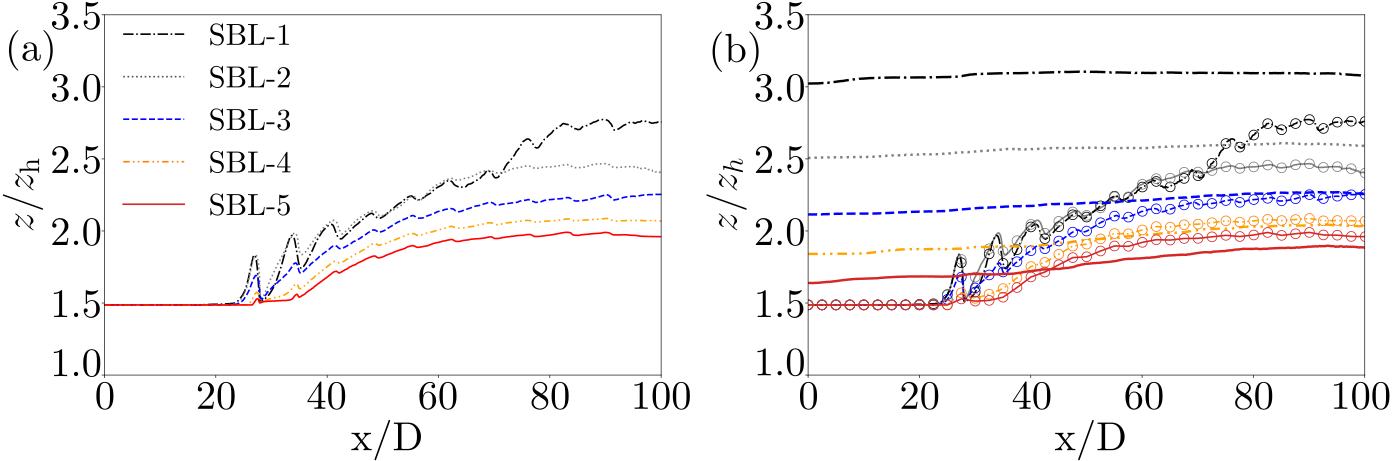
The paper asks how LLJ height and stable stratification jointly affect a finite wind farm and how flow adjusts around it. Wall-modelled Boussinesq LES uses a Lagrangian scale-dependent SGS model, filtered actuator disks (C_T'=1.33), concurrent precursor inflow, streamwise/lateral fringe regions, Rayleigh damping, a hub-direction controller, and individual turbine yaw control.
Why this matters
Use it to show that a farm changes the atmospheric layer and can deplete an LLJ.
Research context
The simulations vary low-level-jet height and stable stratification together. A contradictory Obukhov-regime sentence in the source's budget discussion further limits any claim that separates buoyancy and shear effects.
View in the complete publication list Related atmospheric boundary layer research