Publication 124 · Atmospheric turbulence
Slow wake recovery and low turbulence behind wind farms parameterized in mesoscale simulations
W.C. Radünz, J.H. Kasper, R.J.A.M. Stevens, J.K. Lundquist, Wind Energy Science 11, 2723–2747 (2026).
Main finding
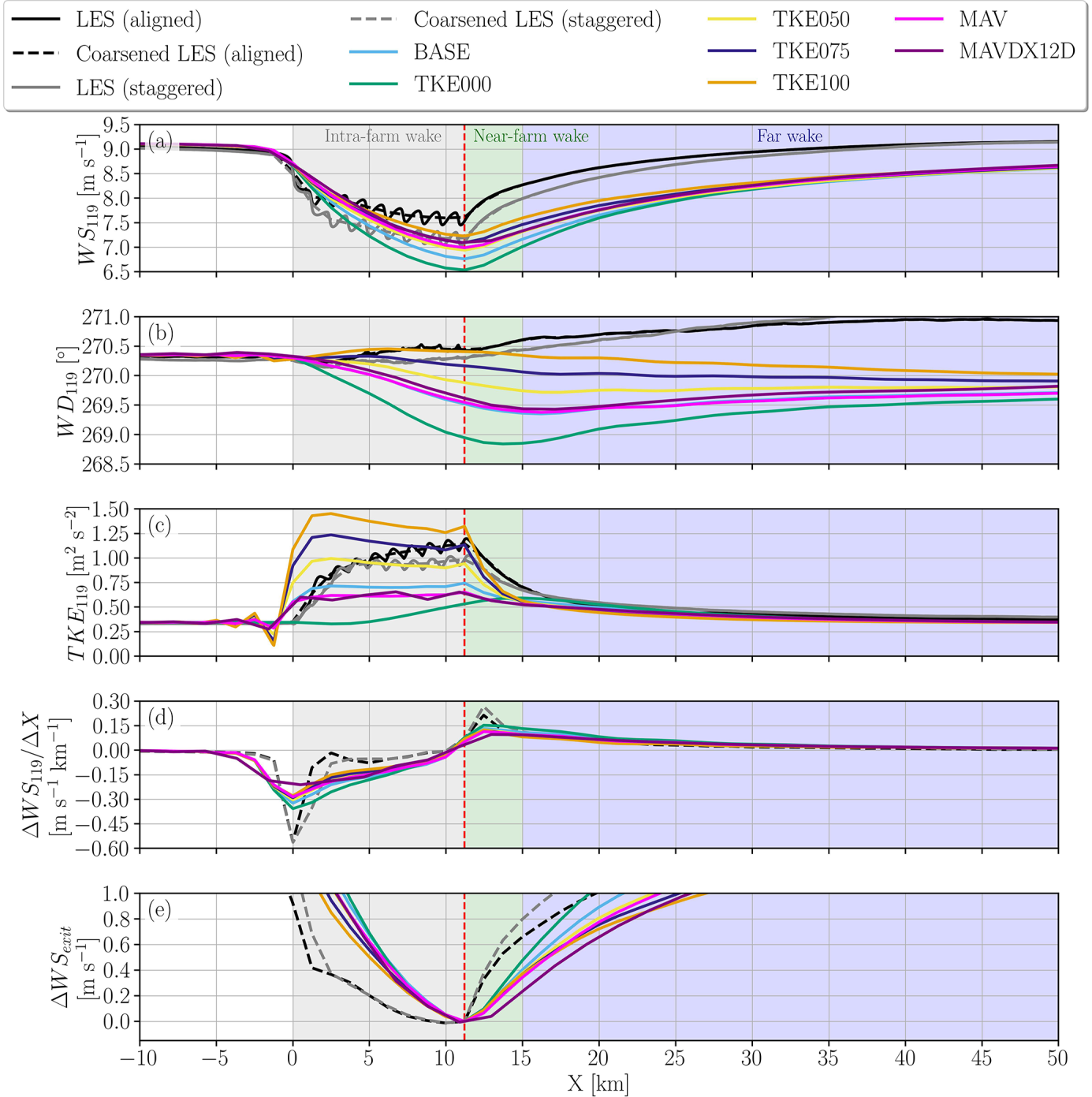
Coarse horizontal grids weaken resolved wake gradients and shear production in the tested mesoscale framework, reducing turbulence and slowing farm-wake recovery. Transfer to other parameterizations or stability regimes requires new tests.
Why this matters
Coarse weather grids can retain wakes too long.
Research context
The comparison uses an idealized neutral LES benchmark to isolate a numerical-weather-prediction bias. Coarse horizontal grids smear the wake deficit, weaken resolved shear production, and slow entrainment; later turbulence and diurnal-forcing studies address additional atmospheric mechanisms rather than this grid-resolution pathway.
View in the complete publication list Related atmospheric boundary layer research