Publication 107 · Ocean and geophysical convection
Toward understanding polar heat transport enhancement in subglacial oceans on icy moons
R. Hartmann, R.J.A.M. Stevens, D. Lohse, R. Verzicco, Geophys. Res. Lett. 51 (3) e2023GL105401 (2024).
Read the article Open-access version
Main finding
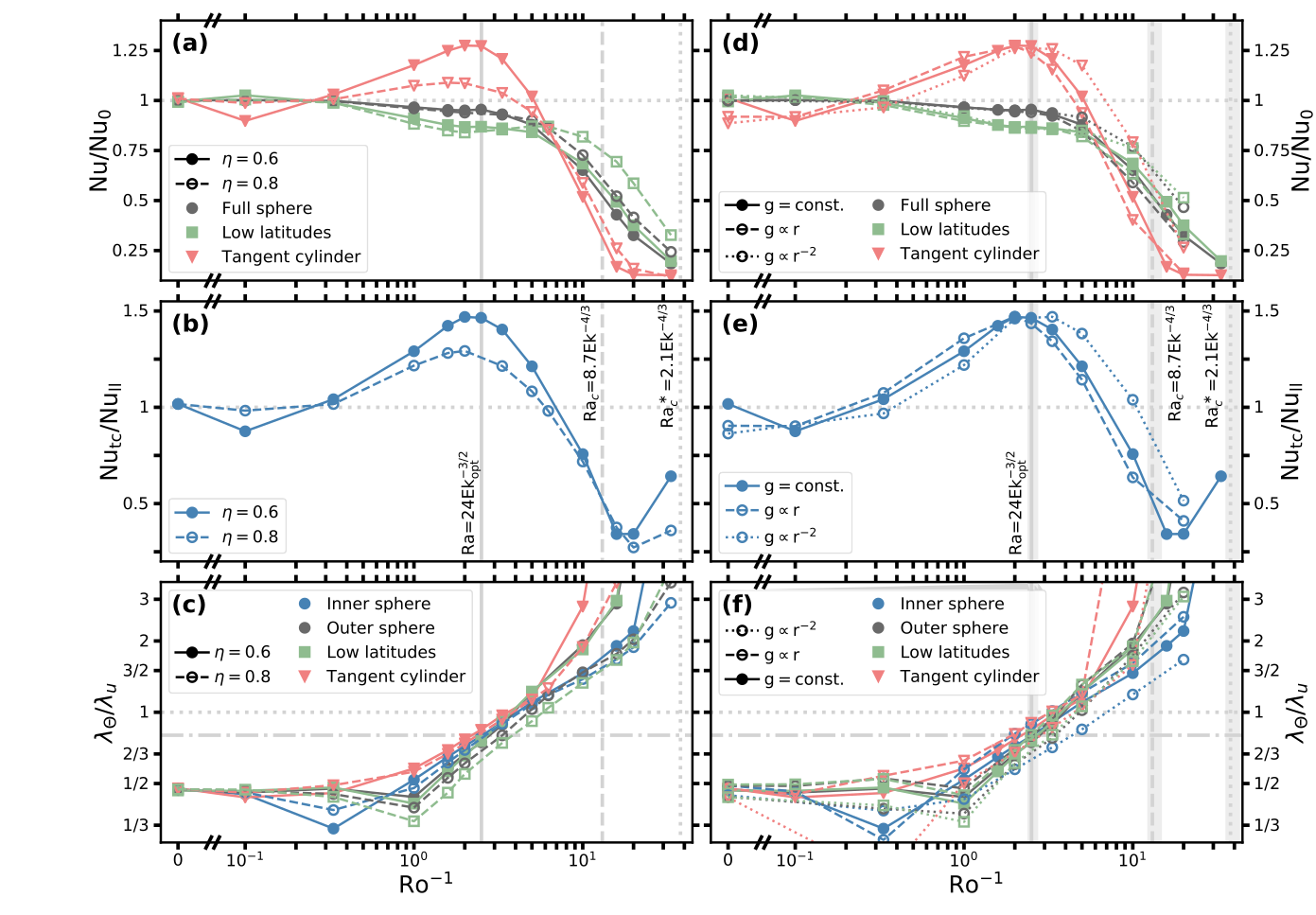
At intermediate rotation, the simulations show enhanced polar heat transport but reduced low-latitude and global transport in the sampled no-slip spherical-convection DNS at Ra = 10^6. The scaling interpretations remain conditional, and application to icy moons is qualitative and quantitatively unvalidated.
Why this matters
Why rotation can redistribute heat toward poles without increasing the global total.
Research context
The spherical-shell calculation extends rotating-convection ideas from cylindrical cells to latitude-dependent geometry. Alignment of buoyancy and rotation permits Taylor-column and Ekman-pumping enhancement near the poles, whereas their near-orthogonal orientation suppresses radial transport at low latitude; salinity and planetary parameter values remain outside the simulated regime.