Publication 38 · Wind-farm flow
Wind Turbine Large-Eddy Simulations on Very Coarse Grid Resolutions using an Actuator Line Model
L.A. Martínez Tossas, R.J.A.M. Stevens, C. Meneveau, 34th Wind Energy Symposium, AIAA SciTech, AIAA 2016-1261, 1-7 (2016).
Read the article Open-access version (arXiv manuscript)
Main finding
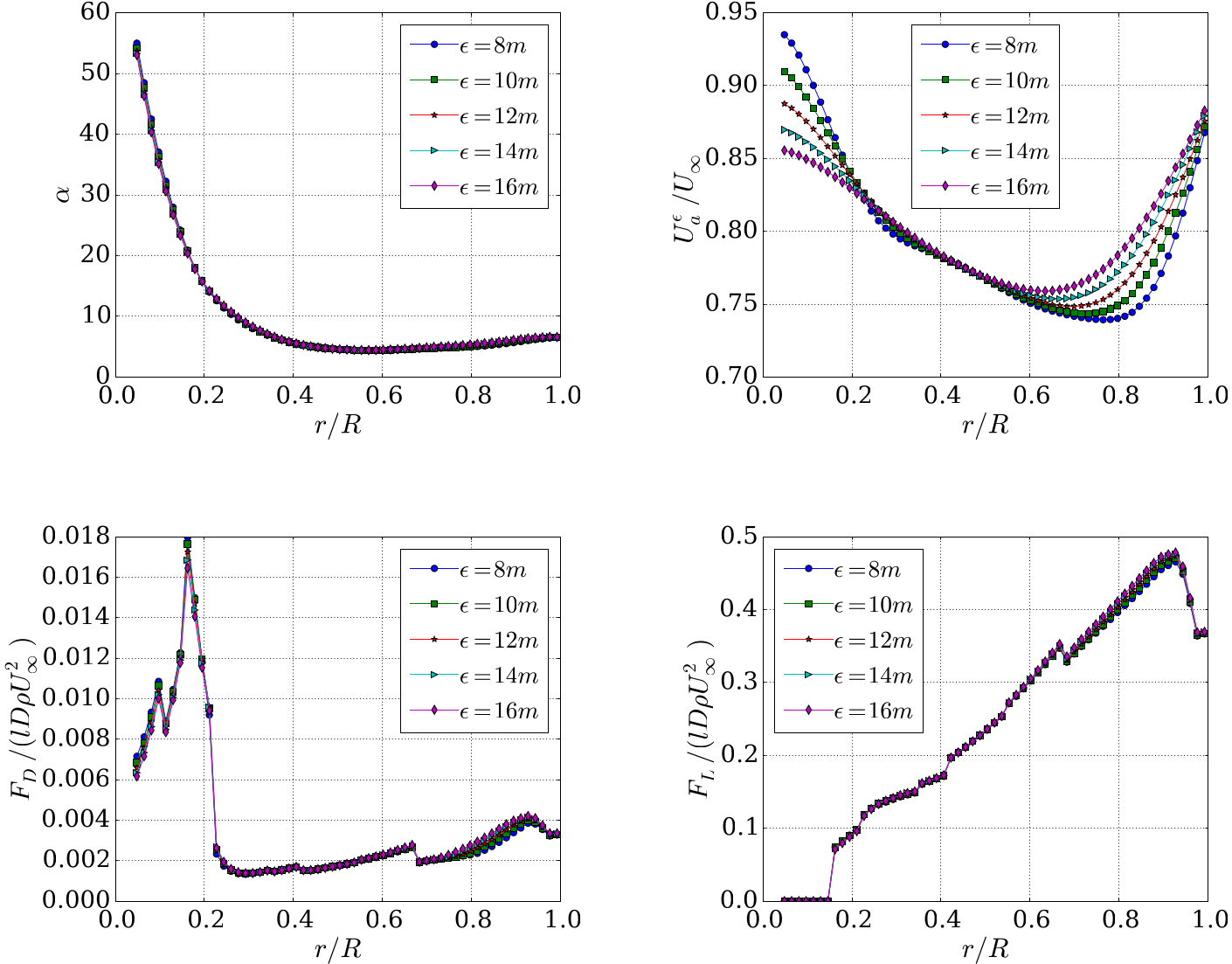
Wake-field agreement is insufficient evidence for actuator loading or power fidelity. Grid spacing, force width, blade-point spacing, and validation target must be audited separately.
Why this matters
A credible wake deficit can coexist with biased actuator loading and power when coarse filtering corrupts the sampled induction.
Research context
The study exposes the projection-kernel and sampled-induction bias that appears when an actuator-line rotor is placed on a very coarse grid. Later PIV validation, farm-scale rotor-model comparisons, grid-versus-actuator-point sweeps, and tip-loading corrections test separate parts of that error hierarchy.
View in the complete publication list Related wind-farm research