Publication 94 · Thermal convection
How rotation and confinement create three heat-transport maxima
R. Hartmann, R. Verzicco, L. Klein Kranenbarg, D. Lohse, and R.J.A.M. Stevens, Journal of Fluid Mechanics 939, A1 (2022).
Read the article Open-access PDF
The article and Figure 1 are open access under CC BY 4.0.
Main finding
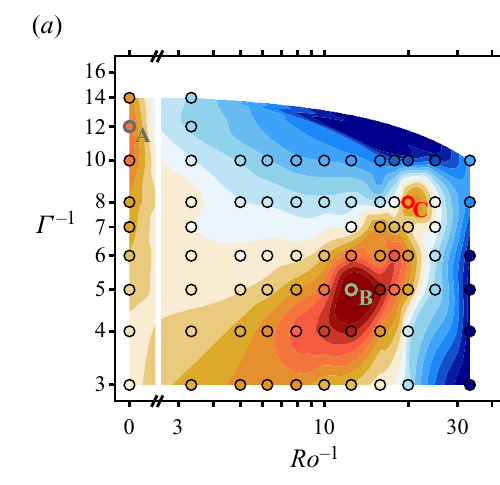
At Ra = 7 × 10⁸ and Pr = 4.38, the sampled rotation-confinement DNS map contained three separated normalized heat-transport maxima: confinement-only, double-vortex, and single-vortex states. Across the four-Rayleigh-number matrix, the double-vortex maximum reached about 50% enhancement at lower Ra but less than 20% at the two higher Ra. The discrete, interpolated cylinder dataset does not define universal optima or uniquely isolate a mechanism.
Why this matters
Rotation and confinement each stabilize convection, but their heat-transport effects do not simply add. Their combination reorganizes the flow into different domain-spanning states, producing several local maxima in the joint control space. Optimizing one control while holding the other implicit can therefore miss the dominant regime or select a response that disappears as thermal driving changes.
Research context
The study contains 323 three-dimensional Boussinesq DNS in a rotating cylinder at fixed Pr = 4.38, four Rayleigh numbers from 2 × 10⁸ to 7 × 10⁹, 0 ≤ Ro−1 ≤ 40, and 2 ≤ Γ−1 ≤ 32. The authors associate the maxima with boundary-layer-controlled heat injection and stable domain-spanning bulk flow. Those contributions are correlated diagnostics, not independently manipulated causal effects. Sampling is discrete and nonuniform; the response-map backgrounds are interpolated, the single-vortex classifier contains an explicitly arbitrary threshold, and the plotted optimum-location bars elsewhere in the paper have no stated uncertainty construction. The simulations use one Prandtl number, cylindrical no-slip boundaries, and one numerical method, with no independent experiment, alternate solver, hysteresis study, initial-state ensemble, or universal scaling law for the coupled optima. The result establishes a nonseparable response within this matrix, not an engineering optimum or a universal transition boundary.
View in the complete publication list Related large-Rayleigh-number study Rotating-convection research