Publication 112 · Wind-energy acoustics
How a steep hill can shield and refocus wind-turbine sound
J. Colas, A. Emmanuelli, D. Dragna, P. Blanc-Benon, B. Cotté, and R.J.A.M. Stevens, Wind Energy Science 9, 1869-1884 (2024).
Read the article Open-access PDF
The article and Figure 18 are open access under CC BY 4.0.
Main finding
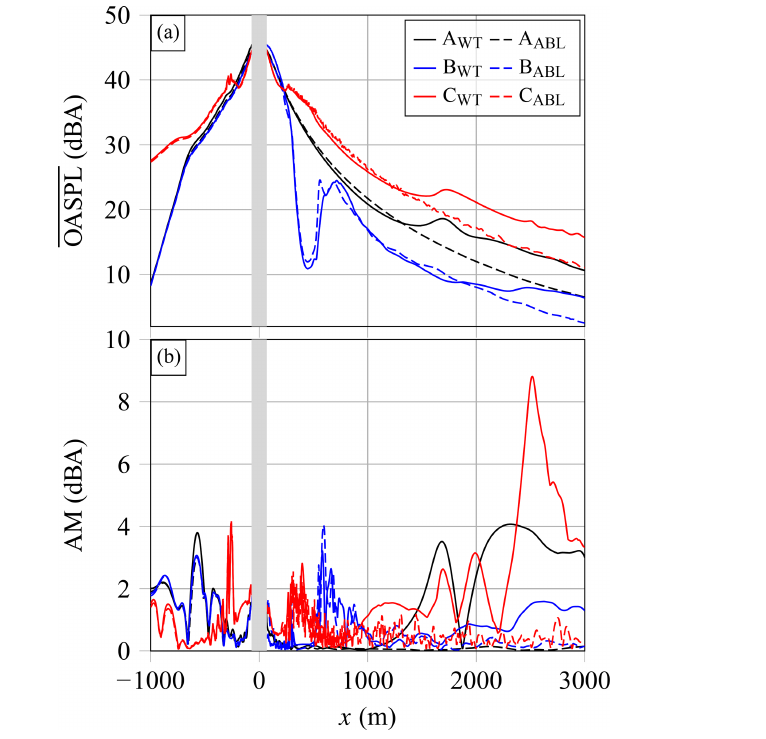
In one neutral, idealized 100 m ridge calculation, placing the turbine immediately upstream produced a strong modeled OASPL dip roughly 250-600 m downwind, but hill-wake refraction restored levels near 700 m to about the flat-case value; farther downwind, levels were about 4 dBA lower than flat. This coupled LES/source/acoustic result is case-specific, not a general siting rule or field validation.
Why this matters
A hill is not merely a geometric barrier to sound. It also changes the mean wind and wake through which sound propagates. Those velocity gradients can bend acoustic paths back toward the ground after a shadow zone, moving rather than simply removing the modeled exposure. Predicting terrain effects therefore requires the source, flow, and propagation calculation to remain coupled.
Research context
The study compares six numerical cases: flat terrain, a turbine immediately upstream of a ridge, and a turbine on the hilltop, each with and without the turbine wake in the propagation mean field. The idealized ridge is 100 m high with a 520 m footprint; the turbine diameter and hub height are 100 m relative to the local ground. The extended-source results use a neutral, constant-temperature atmospheric boundary layer, mean fields from actuator-disk LES, a moving-source model, and linearized Euler propagation in independent vertical planes. The plotted receivers are 2 m above ground and the acoustic calculation covers 50 Hz to 1 kHz. The model omits transverse refraction, wind veer, unsteady turbulent scattering, terrain-dependent source turbulence, operational variability, a terrain ensemble, and field or human-response validation. Grid and source-height convergence are not displayed, and a non-equivalent earlier hilltop study found the opposite far-field ordering. The figure therefore demonstrates a possible shielding-refocusing mechanism within one coupled numerical chain, not a setback distance, permitting result, annoyance prediction, or universal terrain effect.
View in the complete publication list Related acoustics highlights