Selected contributions
Results in wind-farm–atmosphere interaction and turbulence simulation. See the complete bibliography.
Featured papers
Flow Structure and Turbulence in Wind Farms
Wind-farm flow is a coupled multiscale problem: turbine wakes interact with atmospheric-boundary-layer momentum supply, farm development, layout, stability, and larger-scale atmospheric conditions.
How wide must Rayleigh–Bénard cells be to prevent finite aspect ratio effects in turbulent flow?
The cell width needed to avoid sidewall effects depends on which flow quantity is measured. In the tested simulations, heat transport and several mean flow measures approach their wide-cell values at a diameter-to-height ratio of about four; variance and local flow organization require ratios up to 16. These results do not establish a universal width or a sufficient width for ultimate-regime convection.

Modeling Multiscale Atmospheric Interactions in Wind-Farm Power Spectra
The model combines slow wind variations shared across the farm with small-scale turbulence that loses coherence between turbines. Together they describe the tested wind-farm power spectra; the separation of these contributions is not unique, and predictive accuracy on independent data remains untested.
Understanding wind farm power densities
The paper separates wind-farm power loss into a turbine-scale component from interactions within the array and a farm-scale component from the atmospheric boundary layer's response to aggregate drag. This conceptual split clarifies why layout optimization cannot remove the whole-farm momentum-supply limit.

From turbine-scale to wind farm-scale wake recovery: Understanding the transition
Wind-turbine wakes and wind-farm wakes recover through different physical mechanisms. Behind a single turbine, recovery is dominated by spanwise turbulent transport. In the larger wind farms studied, vertical turbulent transport and the downward transport of energy by the mean flow dominate.
Recent highlights
Impact of atmospheric turbulence on performance and loads of wind turbines: knowledge gaps and research challenges
What it established. The review connects atmospheric turbulence across boundary-layer and mesoscale motions with turbine power and structural loads. It identifies the roles of stability, shear, veer, coherence, intermittency and length scale that a single turbulence-intensity measure cannot capture.
Mean turbulent momentum fluxes and wind deficits in nocturnal stable atmospheric boundary layers
A reanalysis of 16 nocturnal stable-boundary-layer simulations separates the streamwise and spanwise momentum fluxes and shows how rotation turns the stress vector with height. Total stress alone therefore cannot determine the profile exponent; the result is a model built from an existing simulation database, not an independent validation.
Four more recent highlights
The global properties of nocturnal stable atmospheric boundary layers
Main finding: Across 20 large-eddy simulations, the nocturnal stable-boundary-layer height follows h ∝ √(LfLs), while the two mean wind-gradient components collapse with u*2/(h2f). The resulting geostrophic-drag coefficients reduce to functions of the stability parameter μ.
Simulation and modeling of wind farms in baroclinic atmospheric boundary layers
The article compares four orientations of baroclinic forcing with a barotropic neutral-surface reference and develops a compact wake model. Boussinesq wall-modelled LES uses AMD and filtered actuator disks (C_T=0.75, induction a=0.25). The domain is 102.4 km x 10.24 km x 10 km, resolved by 2048 x 512 x 384 points (50 m x 20 m, 10 m vertically to 1.5 km, stretched to 62 m aloft).
Modeling wind farm noise emission and propagation: Effects of flow and layout
In one modeled stable-atmosphere case, a staggered 4 × 4 wind farm produced spatially averaged downwind sound levels about 3 dBA higher than the aligned layout beyond 2 km. The coupled calculation attributes the difference to both layout-dependent turbine source emission and sound propagation through the wind-farm flow.
Low-frequency wind speed variations and their impact on wind farm performance
During prescribed low-frequency wind-speed changes, downstream turbine power depends on earlier inflow as well as current speed because wakes take time to advect and adjust. This wake-history asymmetry is demonstrated numerically, not established as a field-validated mesoscale response law.
Programme overview and simulation

The highlights show how the three programme areas — wind-farm–atmosphere interaction, multiscale prediction and physical modelling, and turbulence simulation and high-performance computing — connect fundamental transport physics to predictions of wind-farm performance, atmospheric exchange, flow variability, noise, and heat transport.
Further highlights by theme
Wind-farm turbulence and wake physics
Wake interaction, farm-scale recovery, and turbulent energy replenishment.
Large wind farms operate in a multiscale turbulent flow. Turbine wakes interact with neighboring turbines, merge into farm-scale wakes, and alter the exchange of momentum between the surface layer and the atmosphere above. We use large-eddy simulation and reduced-order modeling to understand these processes and improve predictive wind-farm models. See also the wind-farm LES and analytical wind-farm modeling pages.
- Flow Structure and Turbulence in Wind Farms - also featured above.
- Understanding wind farm power densities - also featured above.
- From turbine-scale to wind farm-scale wake recovery - also featured above.
Enhanced wind-farm performance using windbreaks
What it established. Low windbreaks (h/z_h=0.12) increase total six-row farm power by about 10–14% and first-row power by about 20–25% across the tested distances. Intermediate windbreaks (h/z_h=0.24) can produce larger gains at close placement but become strongly distance dependent; high windbreaks (0.36–0.48) often reduce total farm power.

Effects of turbine spacing on the power output of extended wind-farms
Fully developed power in staggered arrays approximately organizes by the geometric-mean turbine spacing, whereas aligned arrays remain controlled mainly by streamwise spacing; entrance-region and fully developed objectives can therefore favour different layouts.
Impact of wind farm wakes on flow structures in and around downstream wind farms
An upstream wind-farm wake changed power and turbulent transport throughout the downstream farm, not only at its first row. Increasing the gap from 5 to 15 km raised the downstream first-row power from 67% to 87% of the upstream first-row value in the tested staggered cases.
Effect of thrust coefficient on the flow blockage effects in closely-spaced spanwise-infinite turbine arrays
In the tested spanwise-infinite arrays, tight lateral spacing increased first-row power relative to an isolated row, while seven downstream rows decreased it. These opposing layout effects mean that a wind farm's first row is not a neutral reference for blockage or total-farm performance.
Large eddy simulations of the effect of vertical staggering in large wind farms
Vertical staggering increased cumulative power in the first two rows by up to 20% in the strongest tested case, but produced little or negative benefit over the last four rows in most cases. The diagnostics are consistent with local wake avoidance improving the entrance without increasing the downward turbulent energy supply to the deep farm.
Comparison of wind farm large eddy simulations using actuator disk and actuator line models with wind tunnel experiments
The actuator-line model reproduces the near-wake velocity and turbulence profiles better through approximately three rotor diameters. Farther downstream, the mean profiles predicted by the actuator-line and actuator-disk models become increasingly similar. Including nacelle and tower forces further improves the local near-wake prediction.
Atmospheric coupling and wind-energy limits
Stability, low-level jets, geostrophic forcing, and available kinetic energy.
Wind-farm performance is controlled by the atmospheric boundary layer. Stability, low-level jets, baroclinicity, geostrophic forcing, and turbulent momentum transport determine how much kinetic energy is available to the farm and how quickly wakes recover. See also the turbulent boundary layer page.
- Understanding wind farm power densities - also featured above.
- The global properties of nocturnal stable atmospheric boundary layers, and Mean turbulent momentum fluxes and wind deficits in nocturnal stable atmospheric boundary layers - also listed under Recent highlights above.
Geostrophic drag law for conventionally neutral atmospheric boundary layers revisited
Main finding: Across 24 idealized conventionally neutral atmospheric-boundary-layer LES, the dimensionless 5%-momentum-flux height |f|h/u* decreased systematically as the stratification-to-rotation ratio N/|f| increased from 42 to 1350. A curve fitted within the same simulation campaign organized the cases, while selected field estimates showed broad consistency rather than independent validation.
Universal Wind Profile for Conventionally Neutral Atmospheric Boundary Layers
A capping-inversion heat-flux correction captures the full wind profile, including a low-level-jet overshoot, in the calibration LES of conventionally neutral boundary layers. This physically motivated model is not parameter-free or independently validated beyond that simulation family.
Impact of Negative Geostrophic Wind Shear on Wind Farm Performance
The paper tests how a prescribed negative vertical gradient of geostrophic wind changes stable- and neutral-boundary-layer wind-farm performance. Wall-modelled Boussinesq LES uses the AMD SGS closure, concurrent precursor inflow, and actuator-line NREL 5-MW turbines. The 15.36 km x 4.8 km x 4 km domain has 1280 x 640 x 384 points, 12 m x 7.5 m horizontal resolution, 5 m vertical resolution below 1.5 km, and stretching aloft.
Effect of low-level jet height on wind farm performance
The article asks how a fixed stable-boundary-layer LLJ behaves when it lies above, across, or below a farm's rotor-swept area. Boussinesq LES uses a Lagrangian dynamic SGS closure, Monin–Obukhov wall fluxes, filtered actuator disks, concurrent precursor inflow, two-direction fringe layers, Rayleigh damping, and local turbine yaw control. The moderately stable inflow has G=8 m s^-1, f=1.159e-4 s^-1, offshore z_0=0.002 m, surface cooling 0.5 K h^-1, z_i=131.6 m, z_jet approximately 125 m, u_jet/G=1.21, and z_i/L=2.95.
Multiscale wind-farm variability
Power fluctuations driven by atmospheric and array-scale motions.
Wind-farm power varies over seconds, minutes, hours, and longer atmospheric time scales. We study how coherent atmospheric motions, turbulent structures, and turbine-array interactions shape aggregate power fluctuations.
- Modeling Multiscale Atmospheric Interactions in Wind-Farm Power Spectra - also featured above.
- Low-frequency wind speed variations and their impact on wind farm performance - also listed under Recent highlights above.
Temporal structure of aggregate power fluctuations in large-eddy simulations of extended wind-farms
Spanwise turbine signals are nearly uncorrelated, while downstream signals are correlated with an advection-time delay. Streamwise and whole-farm aggregation suppresses intermediate frequencies more strongly than an independent 1/N expectation because delayed correlated signals partially cancel.
A wavenumber-frequency spectral model for atmospheric boundary layers
A random-sweeping model represents atmospheric velocity spectra through mean advection and frequency broadening by larger eddies. Its documented limits preclude treating it as complete dynamics, quantified predictive accuracy or demonstrated wind-farm transfer.
Wind-farm noise and environmental impact
Wake, layout, terrain, and atmospheric effects on sound.
Wind-farm flow physics affects more than power production. Wakes, turbine layout, atmospheric turbulence, and rotor operating conditions influence noise emission, propagation, and amplitude modulation.
- Modeling wind farm noise emission and propagation: Effects of flow and layout - also listed under Recent highlights above.
Wake-induced variations in noise levels and amplitude modulation for two interacting wind turbines
Predicted noise modulation from two turbines changes with their relative rotor phase, speed and wake-modified sound propagation. The illustrative 400 s beat is a sensitivity experiment, not evidence that staggered layouts generate that physical timescale.
Three-dimensional effects of the wake on wind turbine sound propagation using parabolic equation
Lateral gradients of streamwise wake speed refract turbine sound into three-dimensional caustics whose position varies with source height in the model. The calculations do not validate the focal magnitudes or establish a general stability or annoyance rule.
Impact of a Two-Dimensional Steep Hill on Wind Turbine Noise Propagation
Main finding: In one neutral, idealized 100 m ridge calculation, placing the turbine immediately upstream produced a strong modeled OASPL dip roughly 250-600 m downwind, but hill-wake refraction restored levels near 700 m to about the flat-case value; farther downwind, levels were about 4 dBA lower than flat. This coupled LES/source/acoustic result is case-specific, not a general siting rule or field validation.
High-performance simulation and open-source tools
Scalable LES and DNS for wind farms and canonical turbulence.
High-fidelity turbulence simulations require scalable numerical methods and efficient use of modern supercomputers. We develop and use simulation tools for wind-farm LES and canonical DNS, including the open-source AFiD framework.
AFiD-GPU: a versatile Navier-Stokes Solver for Wall-Bounded Turbulent Flows on GPU Clusters
AFiD-GPU is a high-performance implementation of the AFiD incompressible Navier-Stokes solver for GPU clusters. It enables large-scale simulations of canonical turbulent flows such as Rayleigh-Bénard convection, Taylor-Couette flow, channel flow, and plane Couette flow.

Comparison of computational codes for direct numerical simulations of turbulent Rayleigh-Bénard convection
Different simulation codes can agree on global heat transport while under-resolution still distorts local temperature structures. The cross-code comparison validates global observables, not earlier local boundary-layer claims or a hardware-independent performance ranking.
Canonical turbulence and thermal convection
Transport, coherent structures, and scaling in controlled turbulent flows.
Canonical turbulent flows provide controlled systems for studying transport, coherent structures, and scaling behavior. These studies support the physical understanding and numerical methods used across our work on wind-energy and environmental flows. See also the thermal convection page.
Featured above: cell width and finite-size effects in turbulent convection.
Optimal heat transport in rotating Rayleigh-Bénard convection at large Rayleigh numbers
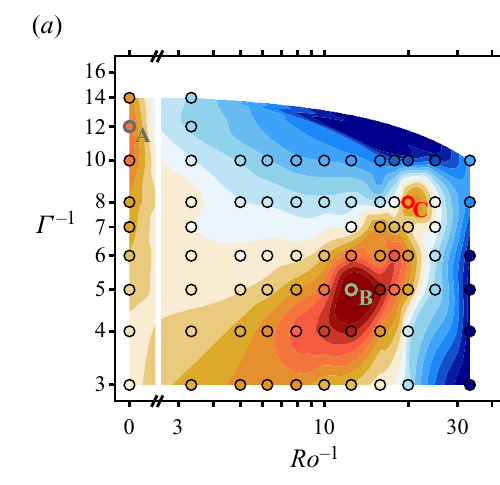
Across the tested rotating-convection DNS, the inverse Rossby number giving the sampled maximum normalized heat transport first increased and then decreased with Rayleigh number. For Pr = 4.38 and 6.4, the maximum enhancement fell from roughly 20%–30% at lower Rayleigh number to about 5% by Ra = 10¹⁰.

Multiple heat transport maxima in confined-rotating Rayleigh-Bénard convection
At Ra = 7 × 10⁸ and Pr = 4.38, the sampled rotation-confinement DNS map contained three separated normalized heat-transport maxima: confinement-only, double-vortex, and single-vortex states. Across the four-Rayleigh-number matrix, the double-vortex maximum reached about 50% enhancement at lower Ra but less than 20% at the two higher Ra. The discrete, interpolated cylinder dataset does not define universal optima or uniquely isolate a mechanism.
Passive scalar transport in Couette flow
Passive-scalar transport in smooth turbulent Couette flow followed Nu ≈ 0.015 Pr^(1/2) Re_b^(3/4) over the tested intermediate range. The scaling is consistent with a Reynolds-analogy link between scalar flux and wall stress, not a universal high-Reynolds-number asymptote.
Strong alignment of prolate ellipsoids in Taylor-Couette flow
In the tested Taylor-vortex flows, larger prolate ellipsoids clustered near vortex cores and developed a sharp tangential alignment. The strongest alignment coincided with low local axial vorticity and reduced particle rotation, but causality was not independently isolated.
Calculation of the mean velocity profile for strongly turbulent Taylor-Couette flow at arbitrary radius ratios
Across the tested radius ratios, a curvature length organized the transition from a near-wall shear-dominated logarithmic layer to a curvature-affected layer and an approximately constant-angular-momentum bulk.
Direct numerical simulations of spiral Taylor-Couette turbulence
Near the simulated laminar–turbulent transition, spiral Taylor–Couette turbulence followed finite-wavelength Ginzburg–Landau-type amplitude scaling. The preferred axial wavelength was 41 ± 2 gap widths at radius ratio 0.91, and the spiral traveled with the domain-mean angular velocity rather than the arithmetic mean cylinder speed.
Direct numerical simulations of Taylor-Couette turbulence: the effects of sand grain roughness
Modeled sand-grain roughness on the inner cylinder increased plume activity, angular-momentum transport, and torque. For this surface, the equivalent sand-grain height was 1.33 times the nominal roughness height and the roughness-sublayer height was 2.78 times the equivalent height.
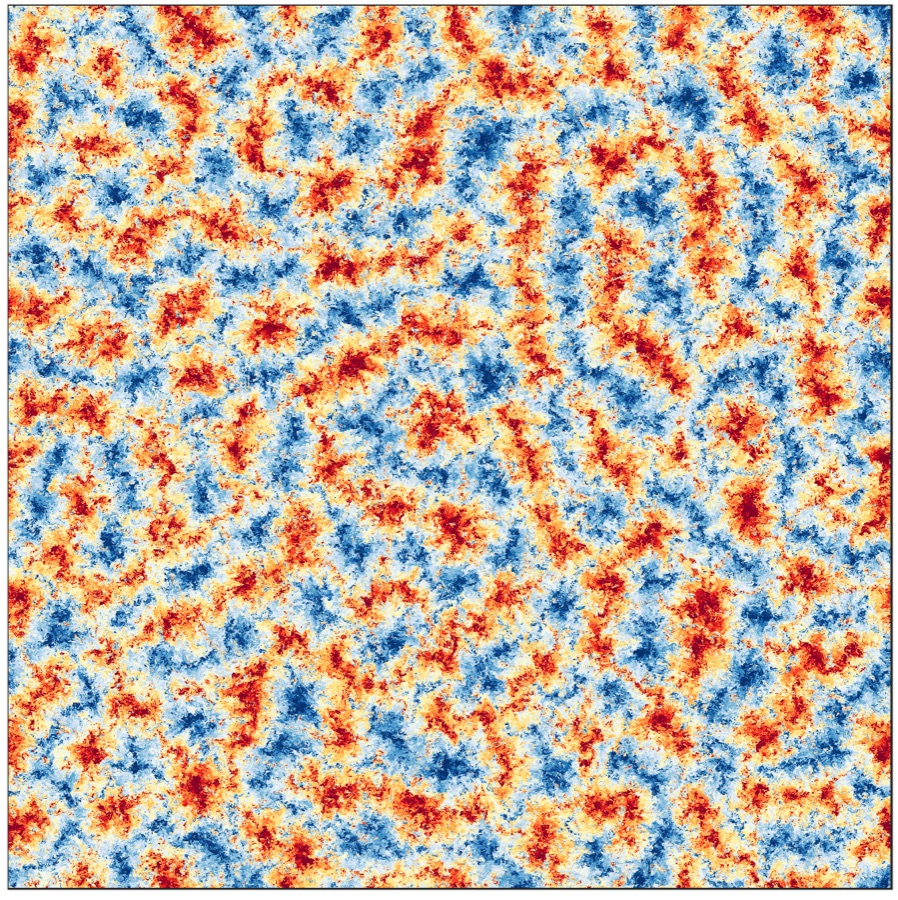
Turbulent thermal superstructures in Rayleigh-Bénard convection
Thermal superstructures persist through Ra=10^9 in the sampled Pr=1 simulations; no weakening with Ra is found over this finite range. Approximate large-domain thresholds reported are Γ≈4 for Nu and volume Reynolds number, 8 for horizontally averaged higher moments and temperature–vertical-velocity correlation, 32 for integral scales, and 64 for spectral peak locations.
Scaling relations for heat and momentum transport in sheared Rayleigh-Bénard convection
Across the tested Couette- and Poiseuille-forced DNS, ReS/ReR organized a common non-monotonic response: moderate shear reoriented and swept thermal plumes, lowering Nu by 18%–26% at the sampled minima, whereas stronger shear produced recovery or enhancement and a friction response consistent with Prandtl's logarithmic law.

For the complete chronological list of peer-reviewed articles, see the publications page.