Publication 3 · Thermal convection
Boundary layers in rotating weakly turbulent Rayleigh-Bénard convection
R.J.A.M. Stevens, H.J.H. Clercx, D. Lohse, Phys. Fluids 22, 085103 (2010).
Read the article Open-access version
Main finding
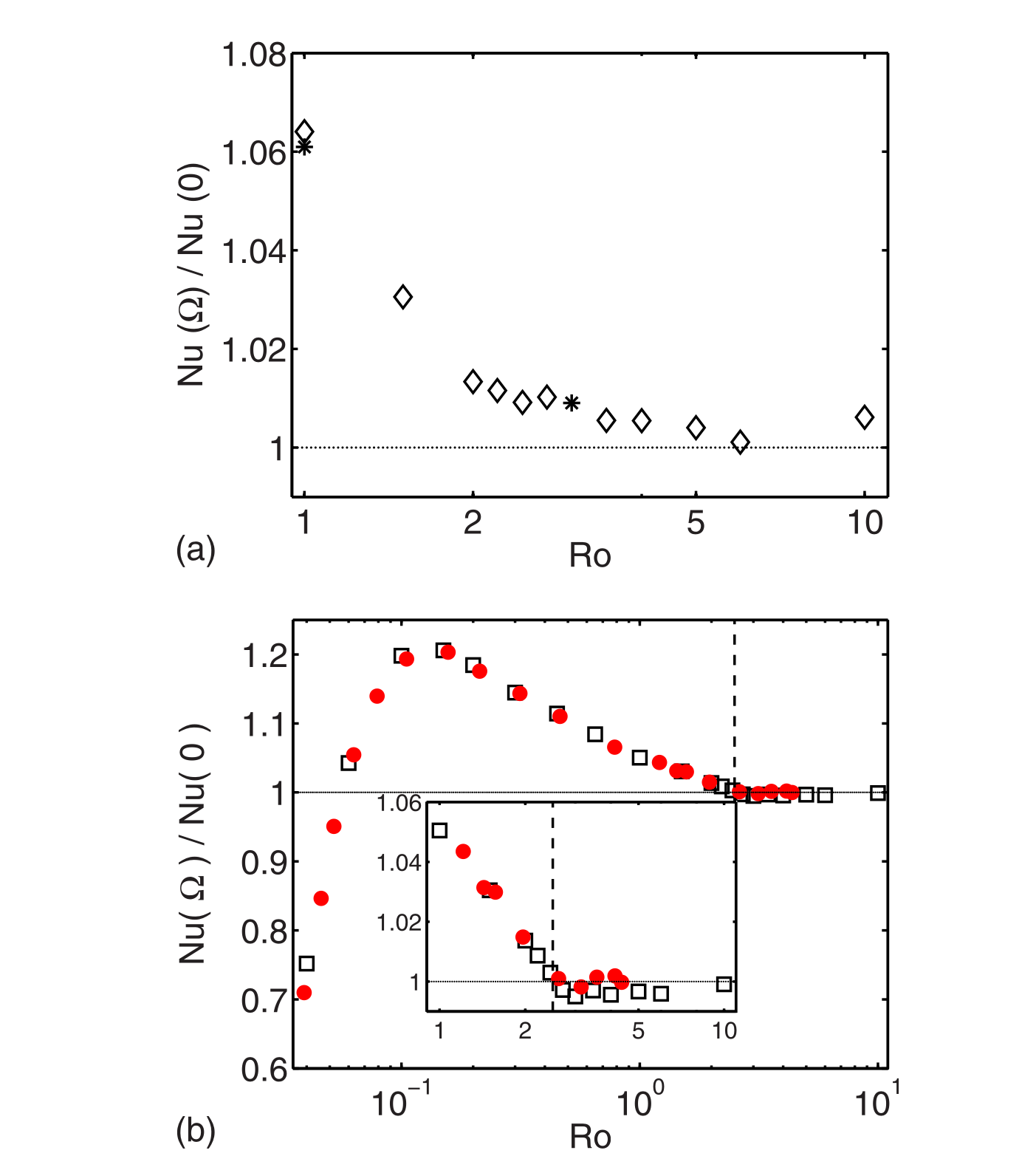
Weak rotation changes the large-scale-circulation-controlled thermal boundary layer smoothly in the low-Rayleigh-number simulations. The proposed laminar scaling is conditional and does not establish a universal turbulent boundary-layer law or predictive transition model.
Why this matters
Rotation can alter heat transfer differently before and after organized pumping appears.
Research context
Earlier heat-transfer maps and state-transition studies define the rotation regime; this paper isolates the accompanying thermal and kinetic boundary-layer response. Later aspect-ratio, sidewall, and flow-state studies test how far that smooth low-Rayleigh-number picture transfers.
View in the complete publication list Related thermal convection research