Publication 117 · Wind-farm flow
Capturing tip-corrected blade element momentum loading with wind turbine models
D. Selvatici, R.J.A.M. Stevens, Renew. Energ. 241, 122265 (2025).
Main finding
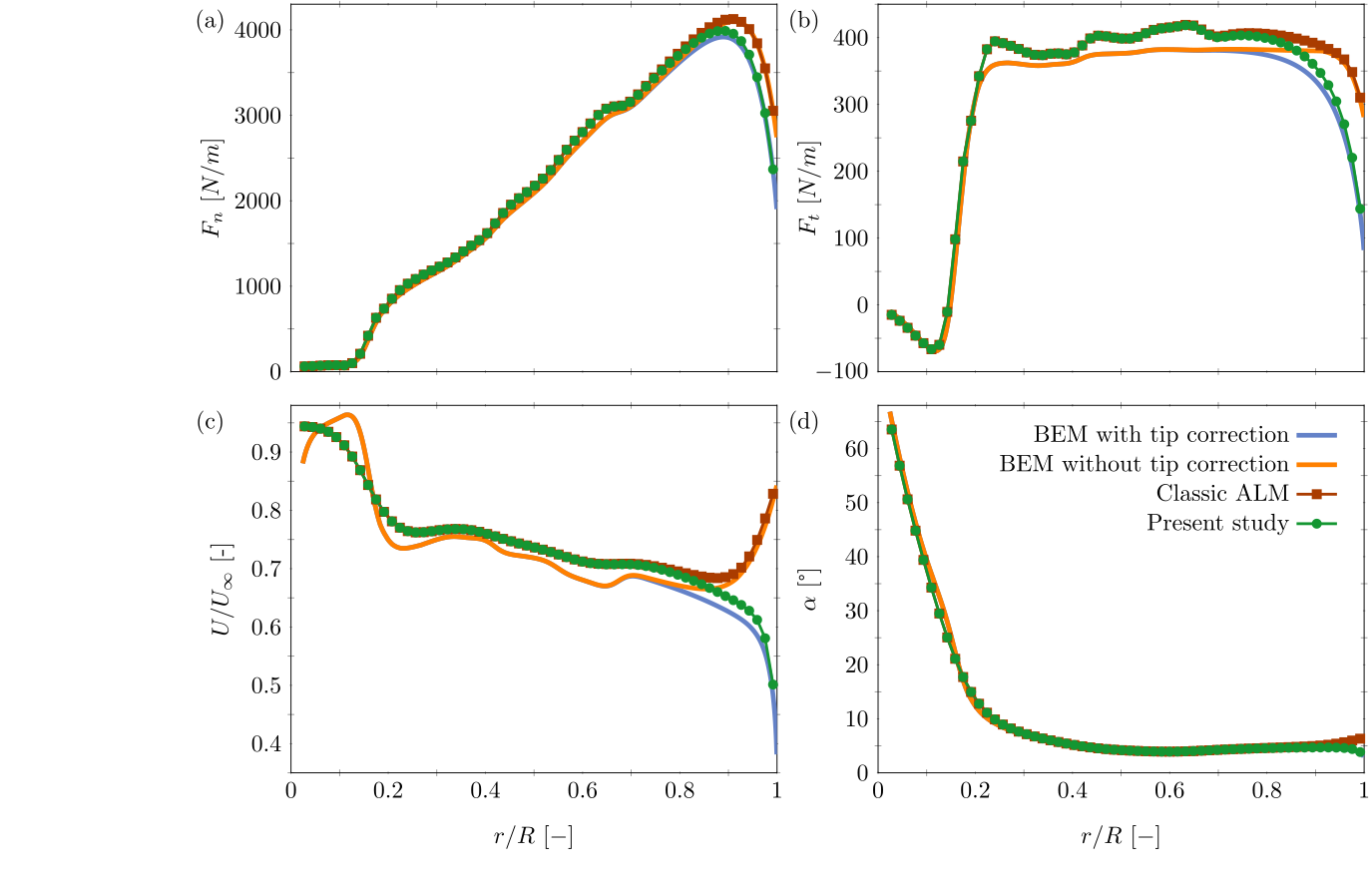
Correcting the velocity sampled by the actuator-line model removes a tip-loading bias relative to the chosen tip-corrected blade-element-momentum target. Agreement with that target does not establish general turbine or wake fidelity.
Why this matters
Correcting the sampled actuator-line velocity removes a tip-loading bias relative to the chosen tip-corrected BEM target.
Research context
Earlier coarse-grid and actuator-line studies show that sampled velocity, force projection, and grid support control the resolved loading. This paper adds a blade-element-momentum-consistent tip correction; later yawed-vortex work examines wake evolution rather than only tip loading.
View in the complete publication list Related wind-farm research