Publication 71 · Thermal convection
Coherence of temperature and velocity superstructures in turbulent Rayleigh-Bénard flow
D. Krug, D. Lohse, R.J.A.M. Stevens, J. Fluid Mech. 887, A2 (2020).
Read the article Open-access version
Main finding
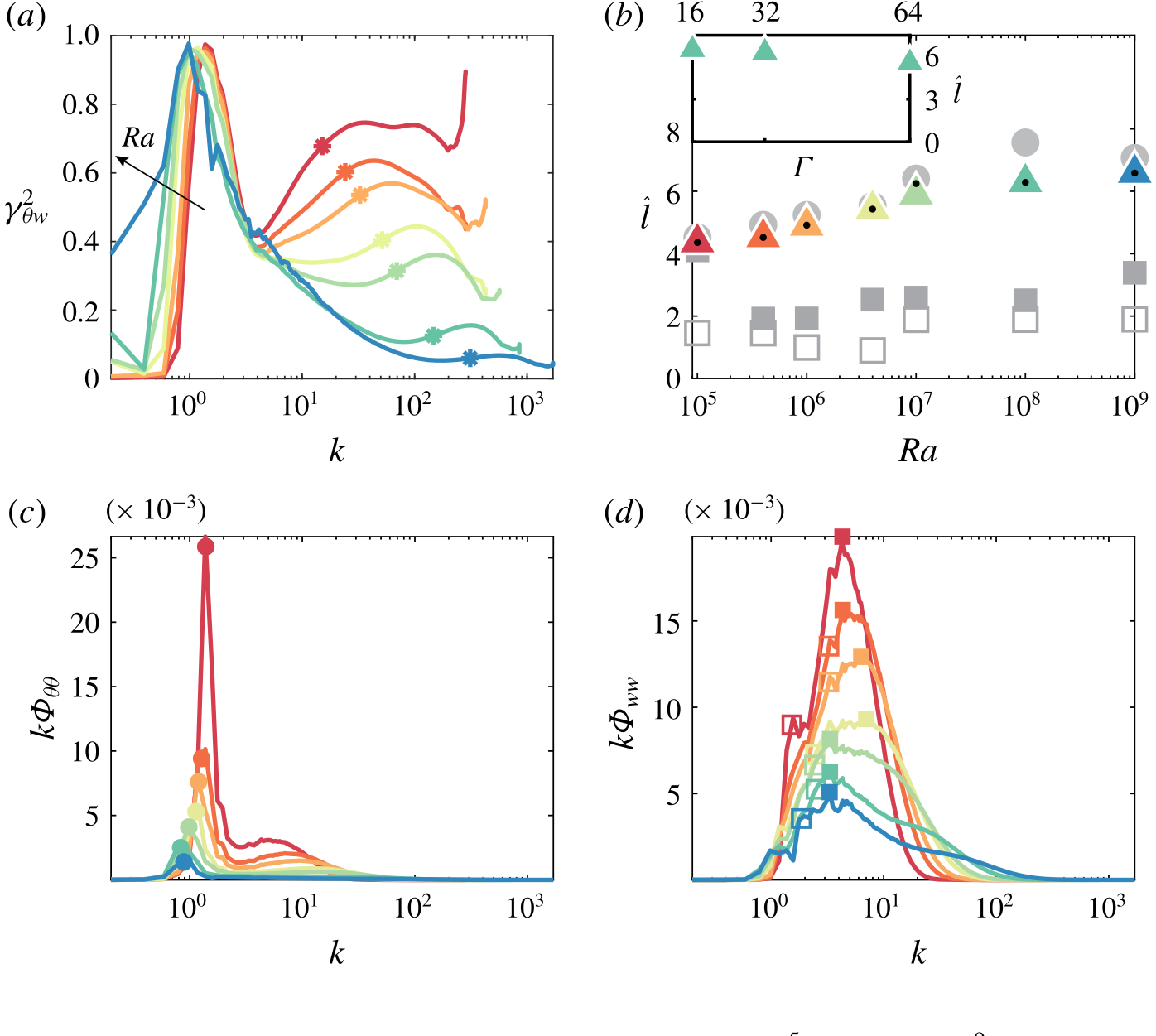
Power-spectrum peak, integral scale, co-spectrum peak, and coherence scale are non-equivalent measures. The apparent smaller velocity superstructure arises because velocity variance is dominated by intermediate scales. Temperature-variance production is concentrated near the wall and at small scales; buoyancy produces vertical-velocity variance across intermediate scales and through the bulk, explaining different spectral weighting.
Why this matters
The work shows why a power-spectrum peak alone can give a misleading measure of coherent structure size.
Research context
This reanalysis corrects the earlier spectral calculation and shows why peak scale, integral scale, co-spectrum, and coherence are not interchangeable diagnostics. Temperature and vertical velocity can remain coherent at large scales even when their variance spectra peak at different wavelengths.
View in the complete publication list Related thermal convection research