Publication 37 · Wind-farm flow
Coupled wake boundary layer model of wind farms
R.J.A.M. Stevens, D.F. Gayme, C. Meneveau, J. Renew. Sustain. Energy 7, 023115 (2015).
Read the article Open-access version (university repository)
Main finding
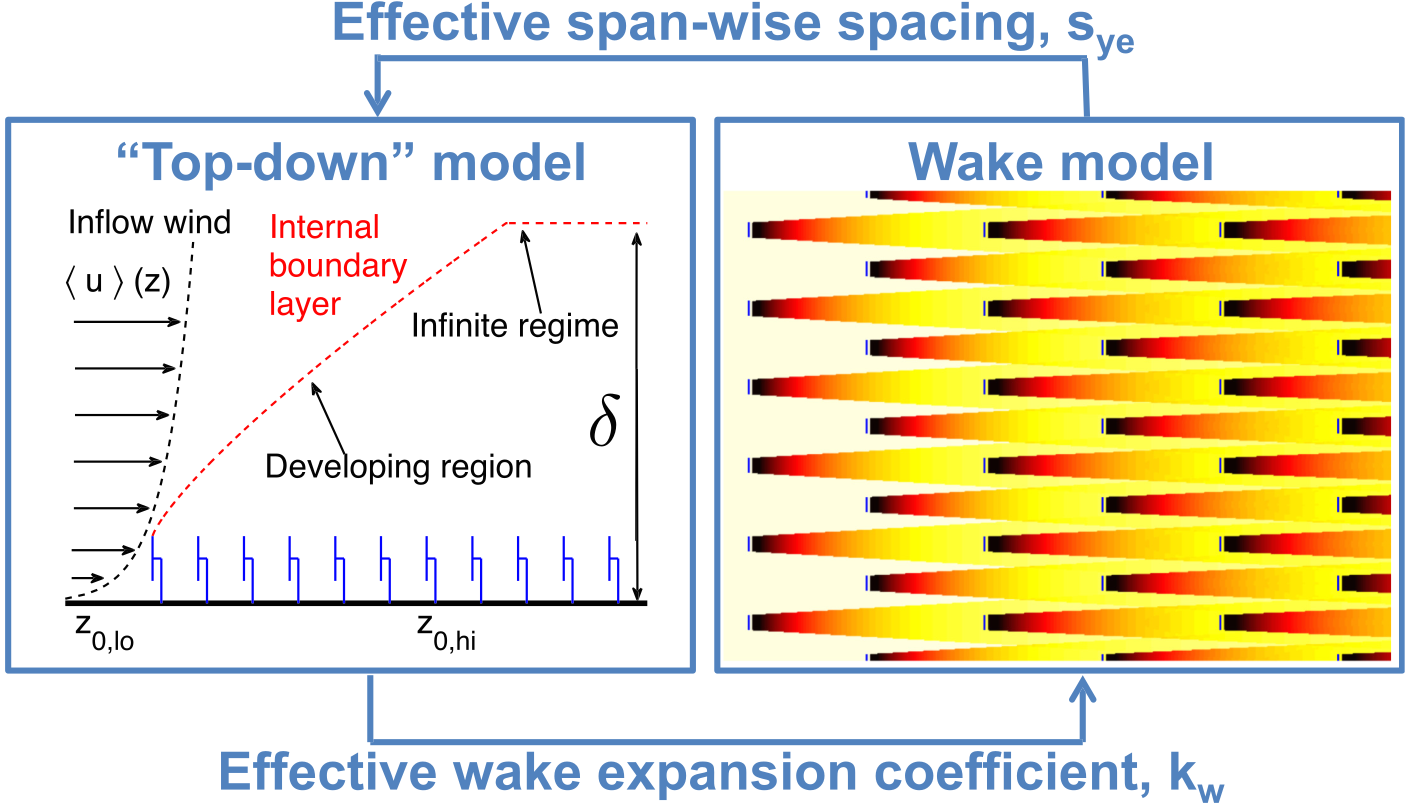
For neutral regular arrays, CWBL improves aggregate power trends by coupling wake geometry to an atmospheric-boundary-layer momentum balance. Its inferred k_w and s_ye are effective closure parameters, and the two selected aligned field-sector comparisons demonstrate plausibility rather than general operational validation.
Why this matters
Why wind-farm performance is multiscale and requires both turbine wakes and atmospheric momentum supply.
Research context
The framework couples turbine-wake overlap to the boundary-layer momentum supply through effective width and wake-growth closures. A generalized formulation (read the finding) extends the layout treatment, while later multiscale work (read the finding) examines downstream recovery mechanisms absent from the 2015 model.
View in the complete publication list Related wind-farm research