Publication 61 · Wind-farm flow
Distinct turbulent regions in the wake of a wind turbine and their inflow-dependent locations
I. Neunaber, M. Hölling, R.J.A.M. Stevens, G. Schepers, J. Peinke, Energies 13, 5392 (2020).
Read the article Open-access version
Main finding
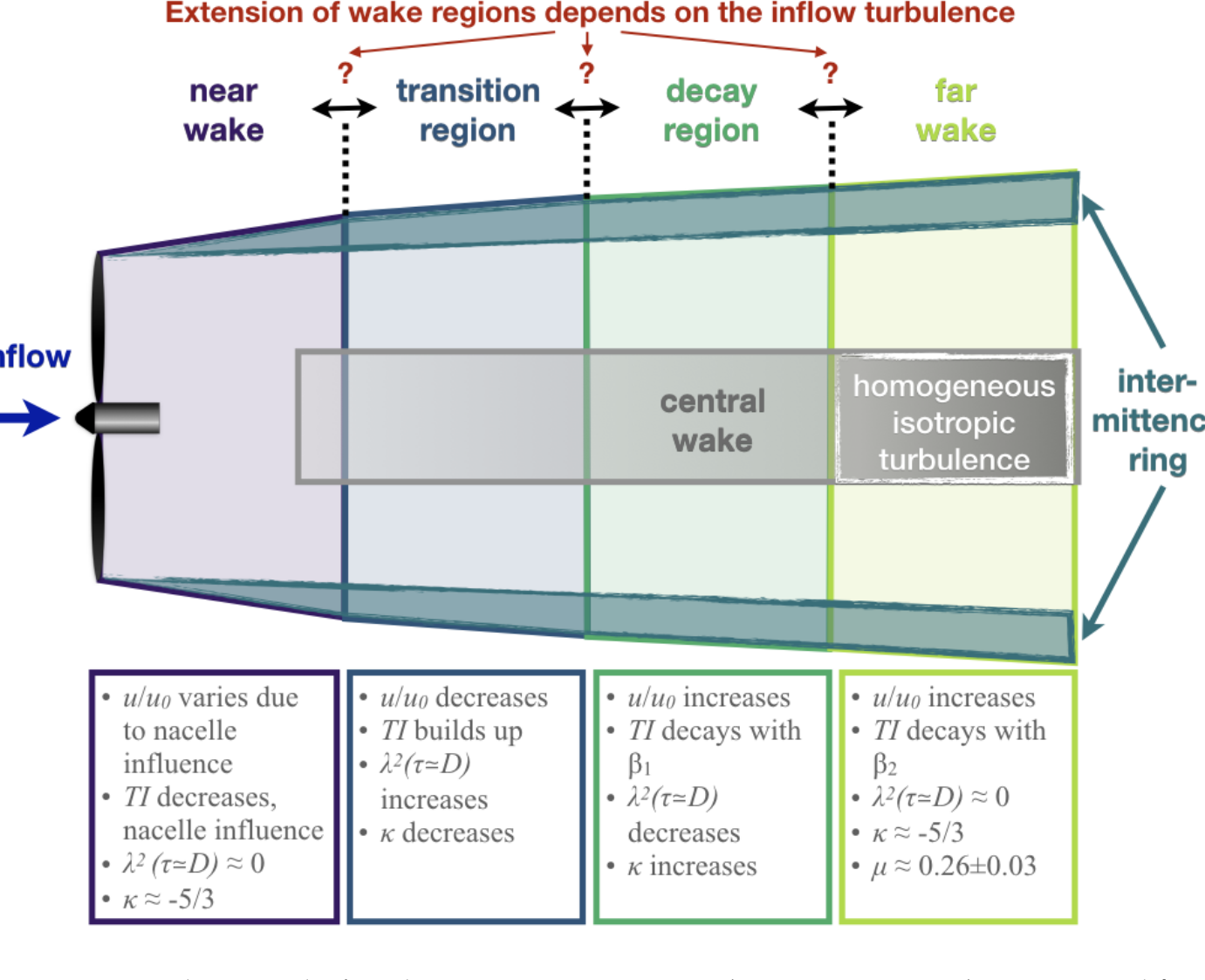
A wake map distinguishes downstream turbulence stages whose locations shift with inflow turbulence in the tested turbine wakes. It provides a conditional diagnostic of model fidelity, not universal transition distances.
Why this matters
Wakes pass through stages whose distances shift with inflow.
Research context
The wind-tunnel map extends earlier near-wake benchmarks from isolated profiles to downstream region placement. Higher inflow turbulence moves vortex breakdown and recovery upstream, so the reported distances are conditional rather than universal; later yawed-vortex simulations address a different instability setting.
View in the complete publication list Related wind-farm research