Publication 12 · Thermal convection
Effect of plumes on measuring the large scale circulation in turbulent Rayleigh-Bénard convection
R.J.A.M. Stevens, H.J.H. Clercx, D. Lohse, Phys. Fluids, 23, 095110 (2011).
Read the article Open-access version (university repository)
Main finding
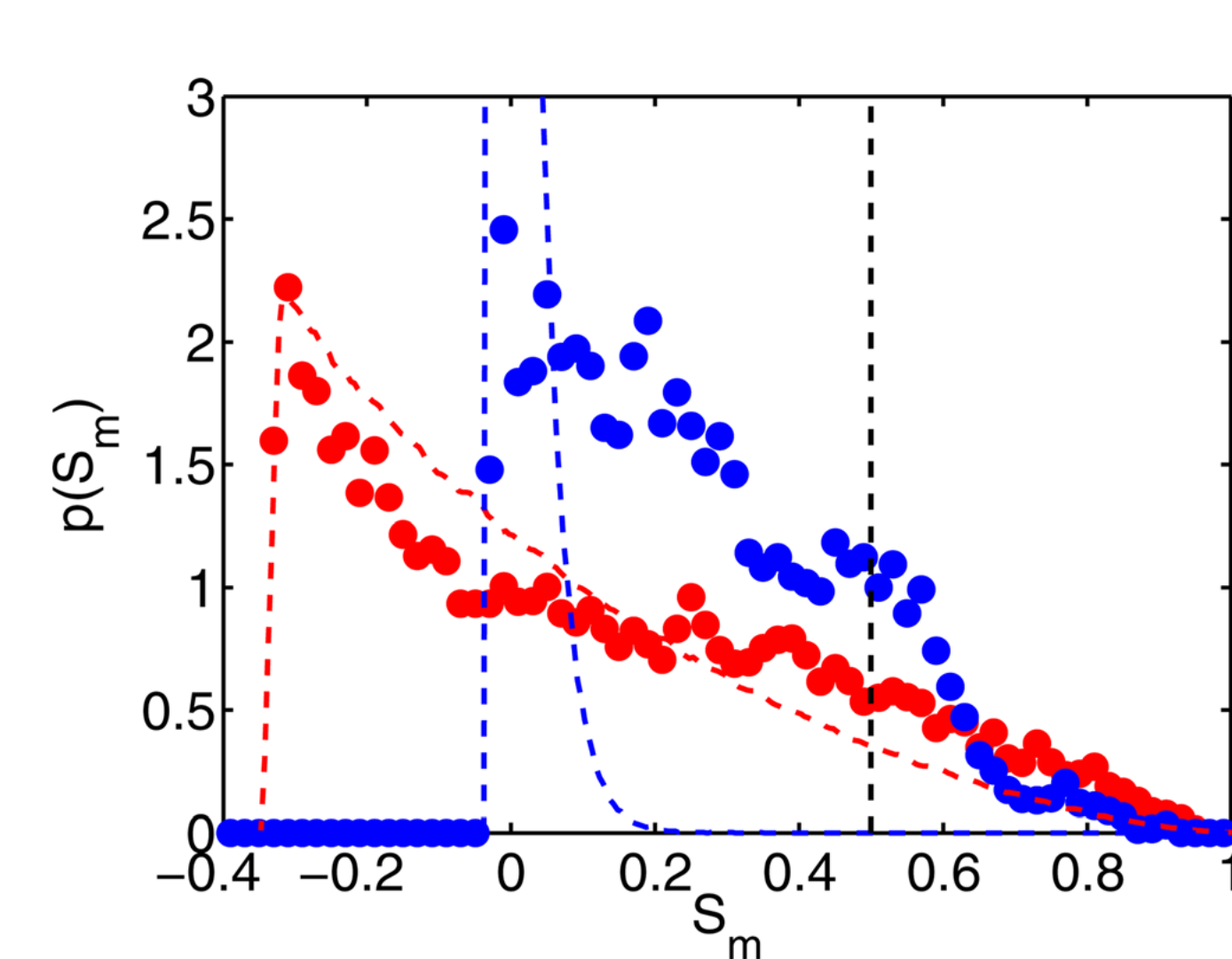
The relative LSC strength compares first-mode energy with all resolvable azimuthal Fourier modes. At Ra=10^8 it is substantially lower in Γ=1/2 than in Γ=1. A cosine-like conditional average can appear even when instantaneous relative LSC strength is low; orientation averaging therefore does not prove a dominant SRS.
Why this matters
The relative LSC strength compares first-mode energy with all resolvable azimuthal Fourier modes. At Ra=10^8 it is substantially lower in Γ=1/2 than in Γ=1.
Research context
Full-field simulations show how sparse azimuthal temperature probes can alias plume and corner-flow structure into the first Fourier mode. The result connects flow-state studies to measurement practice and explains why an orientation-averaged cosine profile is not sufficient evidence for a dominant single-roll state.
View in the complete publication list Related thermal convection research