Publication 76 · Thermal convection
Flow organisation in laterally unconfined Rayleigh-Bénard turbulence
A. Blass, R. Verzicco, D. Lohse, R.J.A.M. Stevens, D. Krug, J. Fluid Mech. 906, A26 (2021).
Read the article Open-access version
Main finding
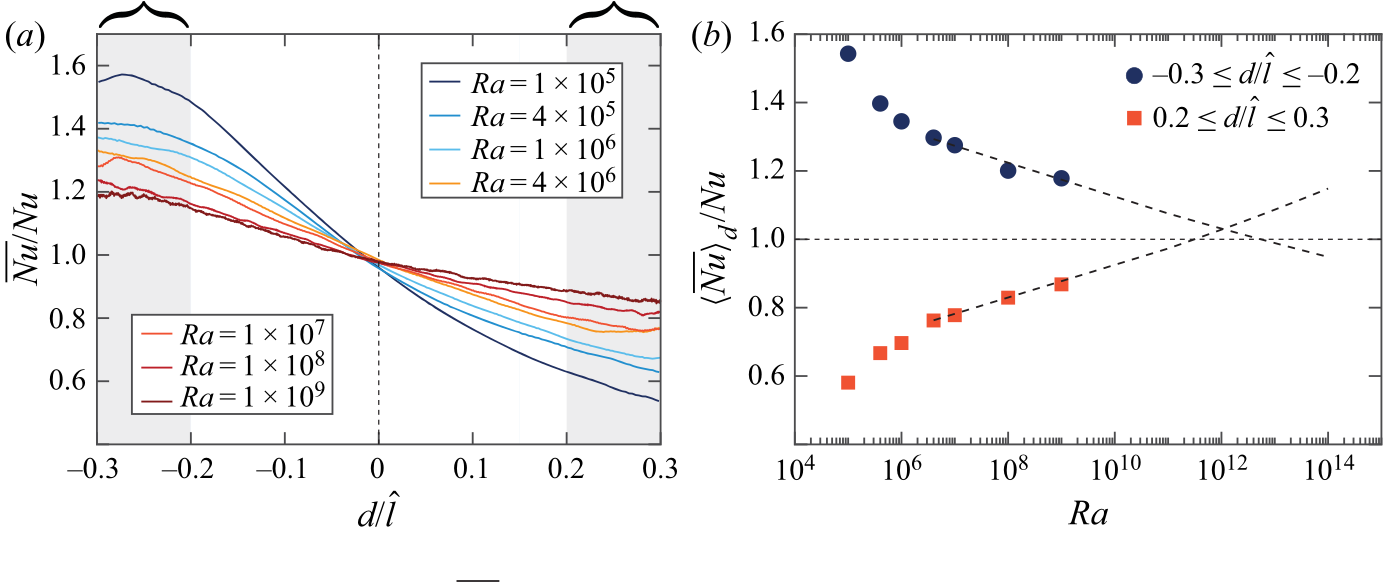
The dominant horizontal structure scale grows from about 4.4H to 6.6H across the tested Ra range. Local Nu is largest in impacting and smallest in emitting regions for every simulated case; the contrast weakens with increasing Ra.
Why this matters
Large patterns organize where heat enters and leaves.
Research context
The wide periodic domain connects earlier two-dimensional flow-state work to the later finite-width study. Large-scale circulation regions organize plume emission and impact at the plates, while the contrast in their local heat flux weakens as the Rayleigh number rises.
View in the complete publication list Related thermal convection research