Publication 70 · Thermal convection
Flow organization and heat transfer in turbulent wall sheared thermal convection
A. Blass, X. Zhu, R. Verzicco, D. Lohse, R.J.A.M. Stevens, J. Fluid Mech. 897, A22 (2020).
Read the article Open-access version
Main finding
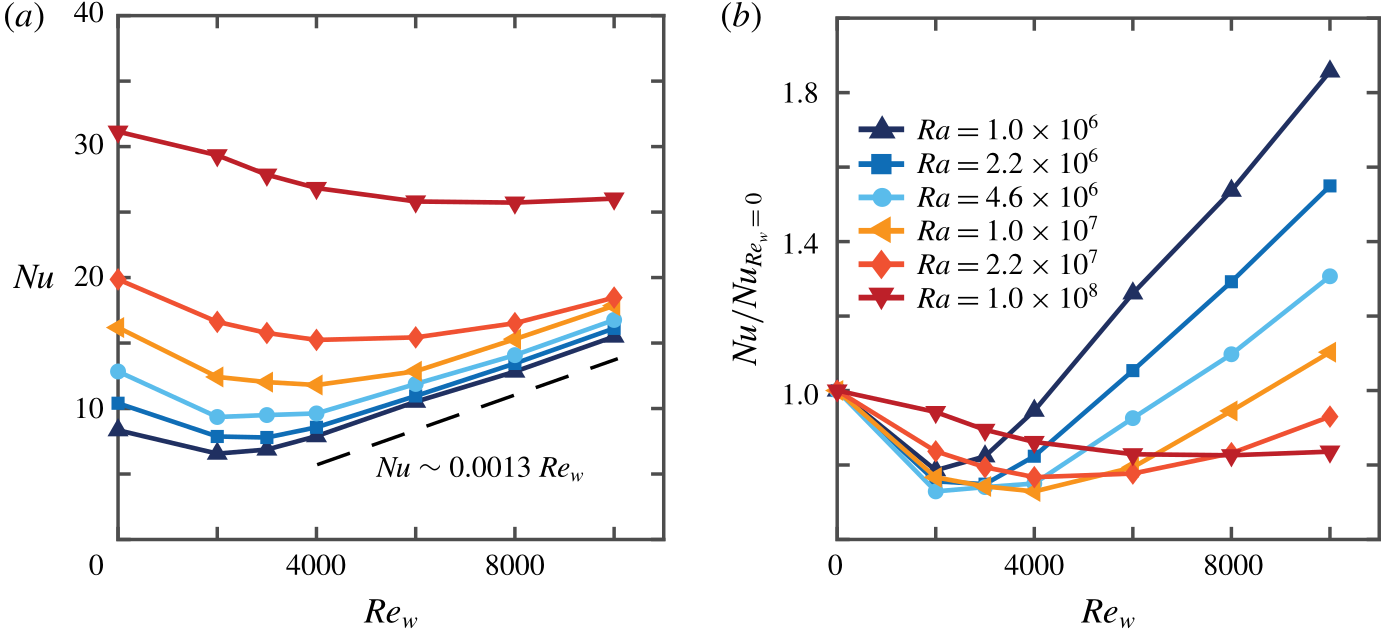
Nonmonotonic transport is directly demonstrated across the simulated matrix. Structure snapshots associate the minimum with thin, straight elongated rolls and later enhancement with very-large-scale meandering streaks. For Couette–RB, L_MO/H ≈ 0.16 Ri^-0.91 over the data, close to but distinct from a cited channel-flow fit.
Why this matters
Nonmonotonic transport is directly demonstrated across the simulated matrix. Structure snapshots associate the minimum with thin, straight elongated rolls and later enhancement with very-large-scale meandering streaks.
Research context
Imposed wall shear first organizes thin, straight rolls near the heat-transfer minimum and then produces meandering very-large-scale streaks as transport rises again. This provides a nonmonotonic forcing pathway distinct from confinement or rotation and links coherent structure directly to transport.
View in the complete publication list Related thermal convection research