Publication 77 · Thermal convection
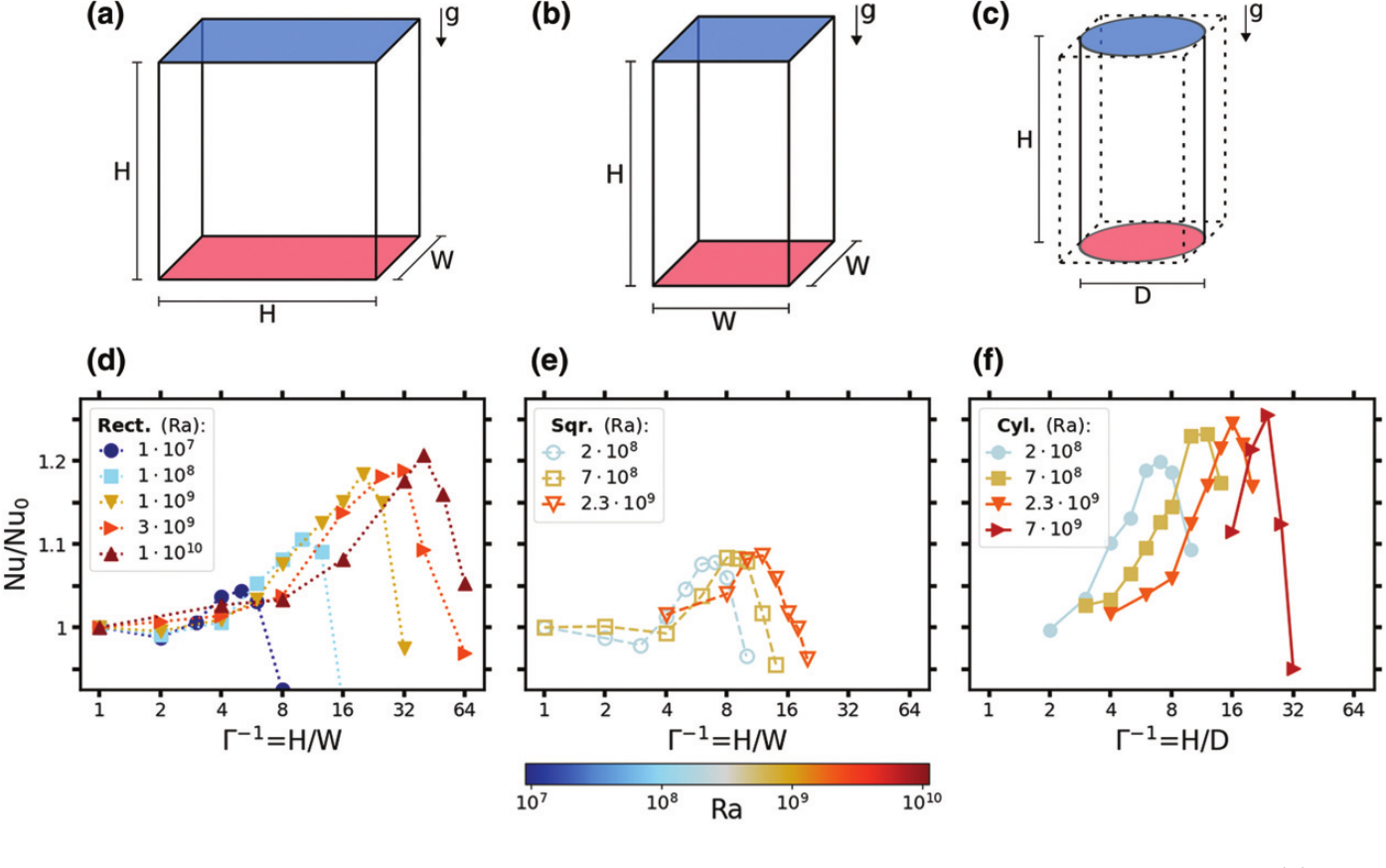
Heat transport enhancement in confined Rayleigh-Bénard convection feels the shape of the container
R. Hartmann, K.L. Chong, R.J.A.M. Stevens, R. Verzicco, D. Lohse, Europhys. Lett. 135, 24004 (2021).
Read the article Open-access version
Main finding
Container shape changes the heat-transport enhancement and coherent flow organization produced by confinement in the simulated convection. The associated scaling and corner-flow interpretation remain conditional.
Why this matters
Container shape changes how plumes connect the plates, shifting the confinement-enhancement curve and coherent flow organization.
Research context
A Prandtl–Blasius sidewall-layer argument gives an approximate quarter-power scaling for the optimal confinement. Square-box data are broadly consistent, whereas rectangular-box data follow a different exponent and require geometry-dependent prefactors.
View in the complete publication list Related thermal convection research