Publication 24 · Thermal convection
Heat transport and flow structure in rotating Rayleigh-Bénard convection
R.J.A.M. Stevens, H.J.H. Clercx, D. Lohse, European Journal of Mechanics B/Fluids 40, 41-49 (2013).
Read the article Open-access version
Main finding
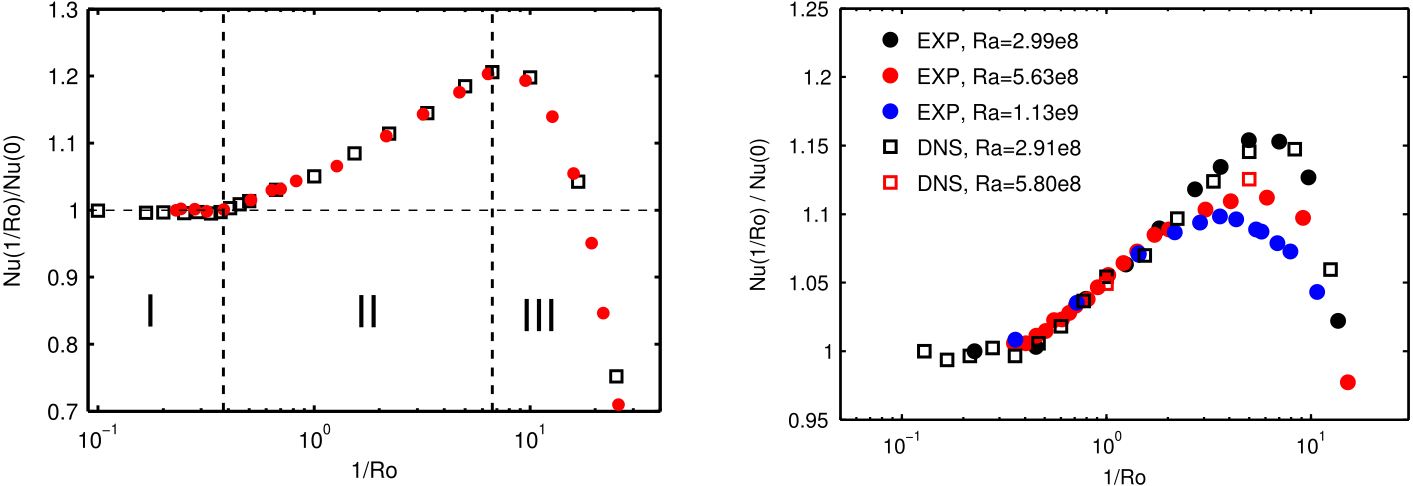
The review connects rotation-induced changes in convection structures and boundary layers to heat-transport enhancement and suppression. It synthesizes earlier studies; quantitative claims require their primary sources and the review adds no independent replication.
Why this matters
Rotation can first enhance and then suppress convection.
Research context
This is a narrative synthesis of published experiments, simulations, and the wider literature rather than an independent numerical campaign. Quantitative results should therefore be attributed to the cited primary studies, while the review supplies the programme-level map from large-scale circulation to Ekman vortices and eventual rotational suppression.
View in the complete publication list Related thermal convection research