Publication 35 · Wall-bounded and rotating shear turbulence
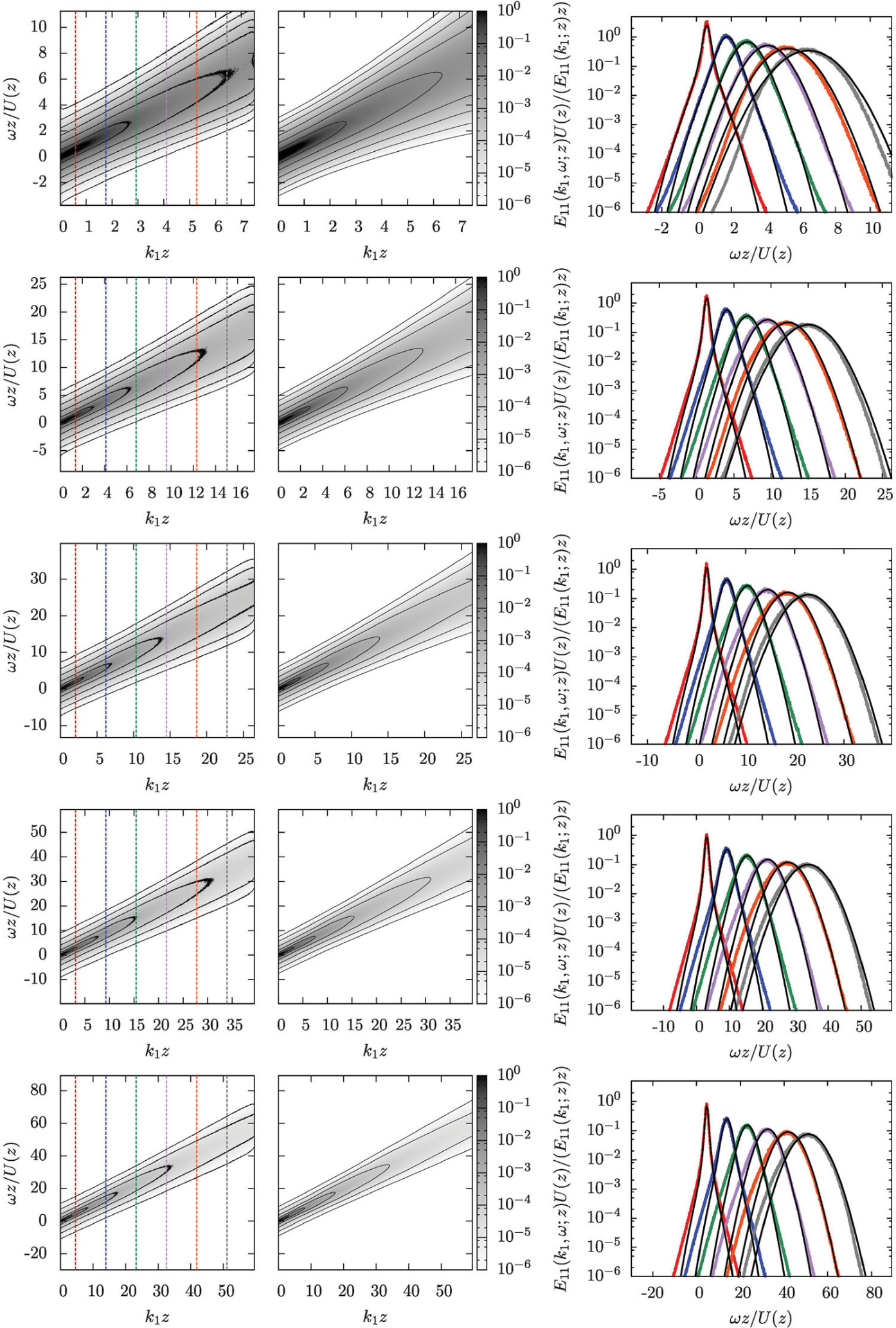
Height-dependence of spatio-temporal spectra of wall-bounded turbulence - LES results and model predictions
M. Wilczek, R.J.A.M. Stevens, C. Meneveau, J. Turbulence 16, 937-949 (2015).
Read the article Open-access version (university repository)
Main finding
Large energy-containing eddies sweep smaller eddies and broaden their frequency distribution with height in the tested wall turbulence. The model assumptions and LES resolution limit its interpretation as a complete or uniquely validated dynamical model.
Why this matters
Large energy-containing eddies sweep smaller eddies, broadening their frequency distribution in a height-dependent manner.
Research context
The analysis extends the full wavenumber–frequency model from one logarithmic-layer height to five heights and a factor-of-two grid comparison using the same rough-wall LES family. Wind-farm use is proposed as an application, not demonstrated by the simulations in this paper.
View in the complete publication list Related Taylor-Couette research