Publication 95 · Atmospheric turbulence
Investigating wind farm blockage in a neutral boundary layer using large-eddy simulations
J. Strickland, R.J.A.M. Stevens, Eur. J. Mech. - B/Fluids 95, 303–314 (2022).
Main finding
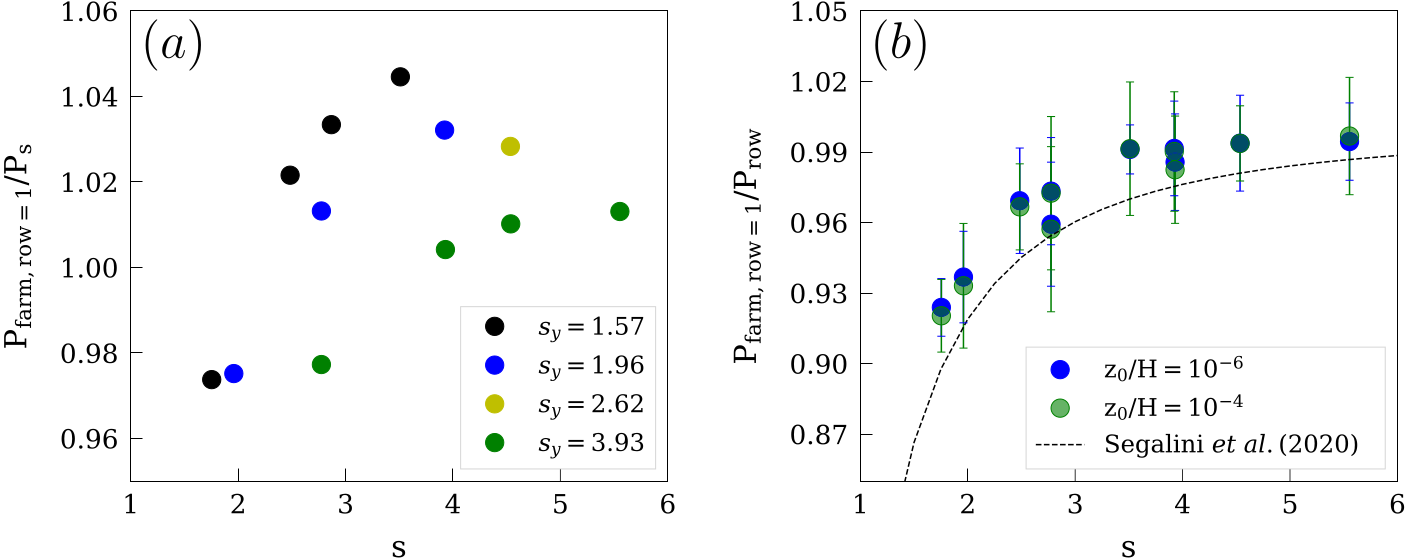
Wind-farm blockage estimates depend on layout and the chosen reference velocity in the tested LES. The associated adverse pressure gradients do not uniquely establish pressure or mass-conservation dominance, or general insensitivity to turbulence.
Why this matters
Why front-row turbines are not a neutral reference.
Research context
The finite-farm simulations connect earlier alignment, spacing, and thrust-coefficient studies to an explicit upstream slowdown. The later stable-boundary-layer study (read the finding) adds surface cooling and pressure-response effects while separating them from a capping-inversion gravity-wave pathway.
Related findings: Wind farm blockage in a stable atmospheric boundary layer; From turbine-scale to wind farm-scale wake recovery: Understanding the transition.
View in the complete publication list Related atmospheric boundary layer research