Publication 20 · Thermal convection
Logarithmic temperature profiles in turbulent Rayleigh-Bénard convection
G. Ahlers, E. Bodenschatz, D. Funfschilling, S. Grossmann, X. He, D. Lohse, R.J.A.M. Stevens, R. Verzicco, Phys. Rev. Lett. 109, 114501 (2012).
Read the article Open-access version (university repository)
Main finding
The paper provides strong profile-shape evidence for selected intervals and strong DNS evidence of classical radial nonuniformity. It does not establish a universal bulk temperature log law, direct experiment–DNS validation, or a common shear-flow mechanism.
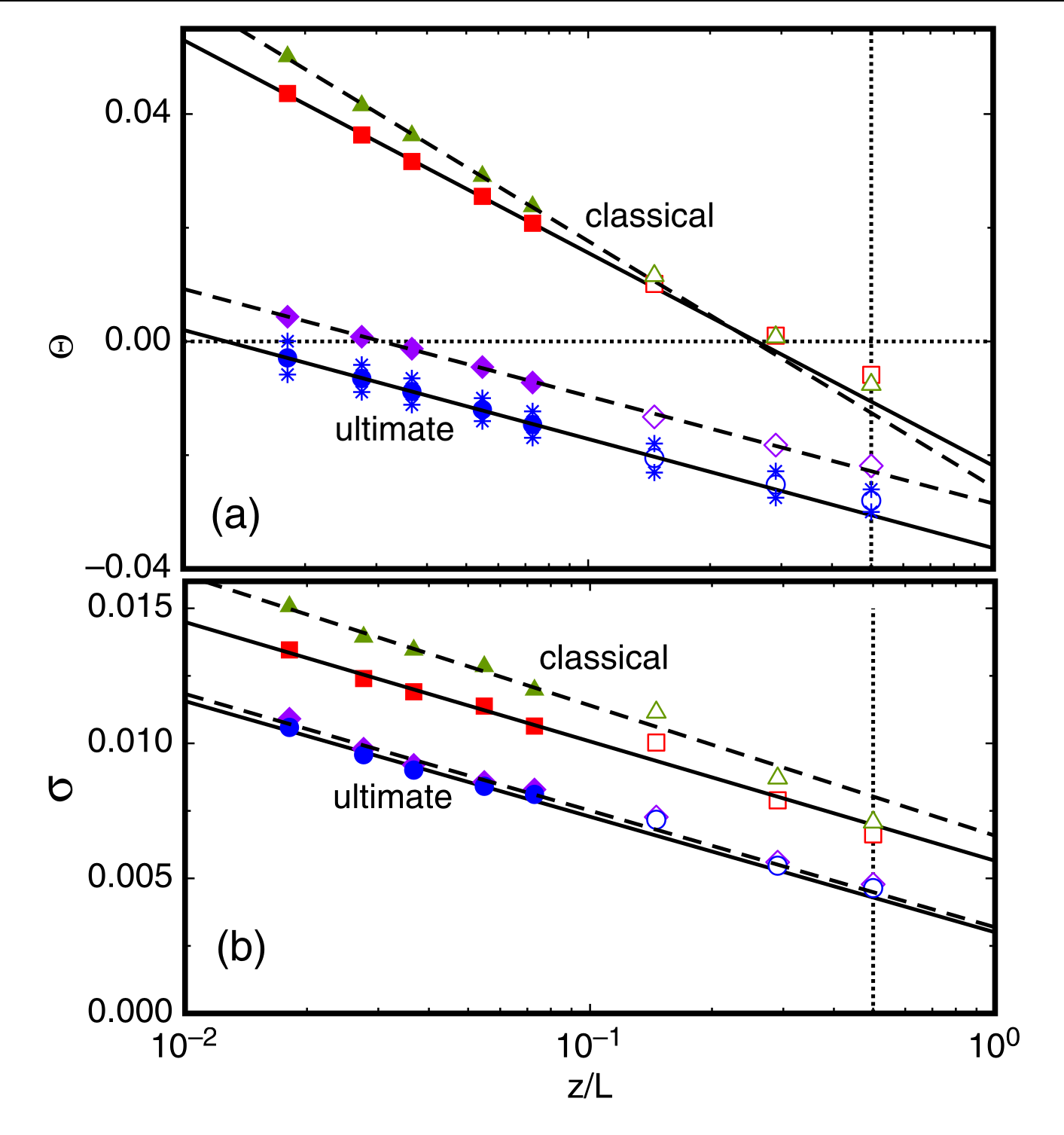
Why this matters
A simple-looking logarithmic profile can reveal organized structure in a turbulent interior.
Research context
The cylindrical DNS lineage supplies an important local-resolution warning: agreement in global heat transfer does not validate a spatially resolved temperature profile. Related boundary-layer studies constrain the Prandtl–Blasius comparison, but none independently validates the present logarithmic fits or turns them into a universal bulk law.
View in the complete publication list Related thermal convection research