Publication 84 · Wind-farm flow
Modeling dynamic wind direction changes in large eddy simulations of wind farms
A. Stieren, S.N. Gadde, R.J.A.M. Stevens, Renewable Energy 170, 1342-1352 (2021).
Main finding
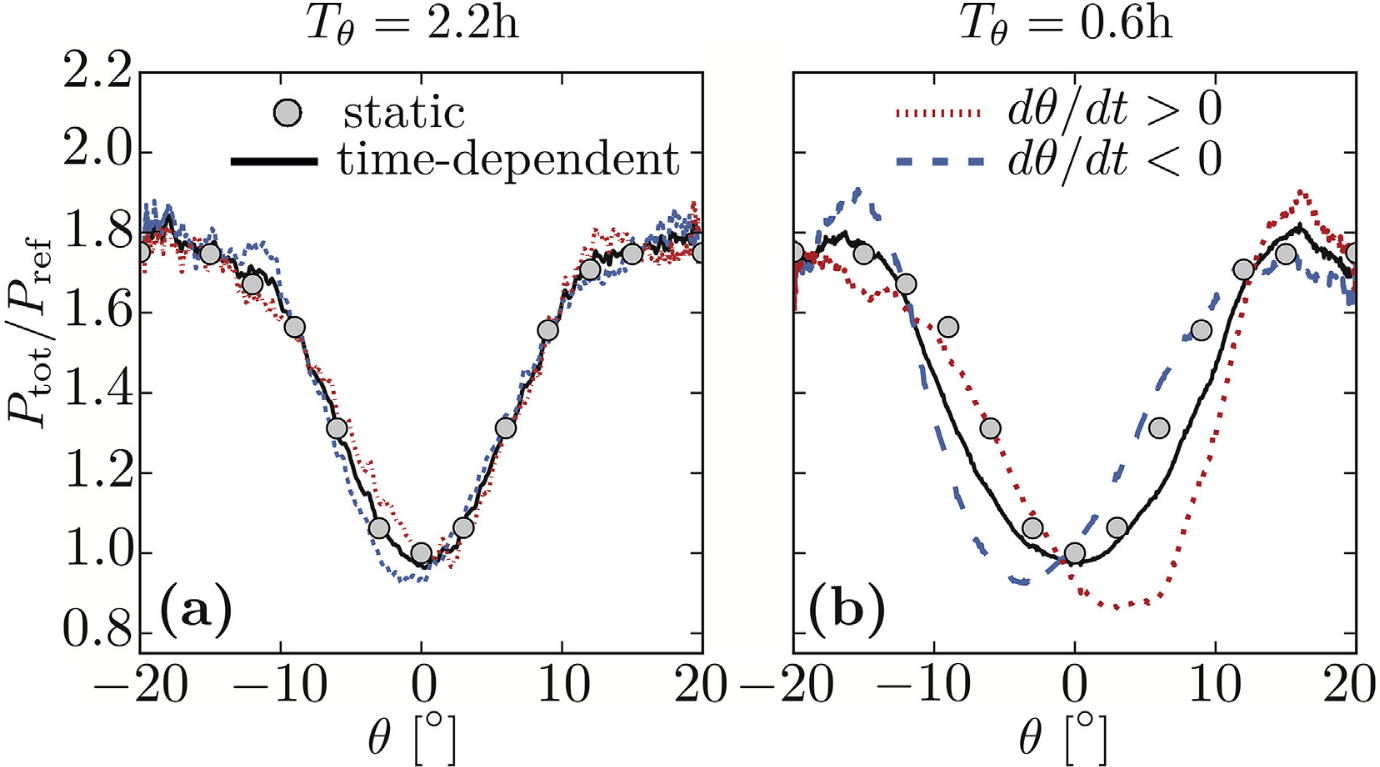
Rapid wind-direction changes produce wake hysteresis in the tested LES because turbines encounter structures generated under earlier inflow directions. The response magnitude and mechanism do not define general wind-farm laws.
Why this matters
Rapid wind-direction changes produce wake hysteresis because turbines encounter structures generated under earlier inflow directions.
Research context
Builds on concurrent-precursor and time-varying-direction methods cited, and on Flow Structure and Turbulence in Wind Farms (read the finding). Complements Modeling space-time correlations of velocity fluctuations in wind farms (read the finding) and Turbulence coherence in wind farms (read the finding) by adding nonstationary direction forcing rather than stationary correlation/coherence.
View in the complete publication list Related wind-farm research