Publication 14 · Thermal convection
The role of Stewartson and Ekman layers in turbulent rotating Rayleigh-Bénard convection
R.P.J. Kunnen, R.J.A.M. Stevens, J. Overkamp, C. Sun, G.J.F. van Heijst, H.J.H. Clercx, J. Fluid Mech. 688, 422-442 (2011).
Read the article Open-access version (arXiv manuscript)
Main finding
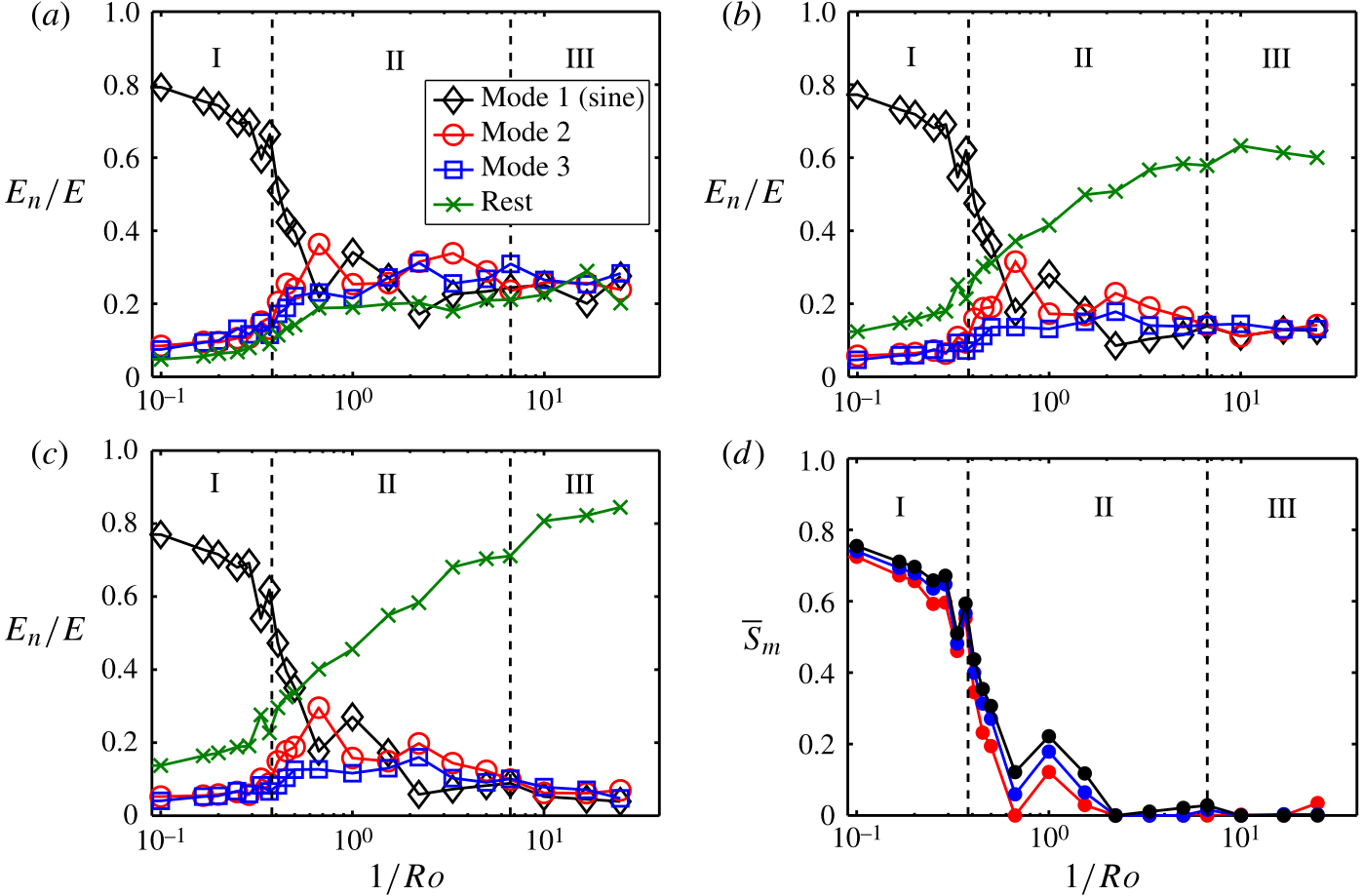
The mean vertical sidewall-temperature gradient persists in regimes II and III after the coherent first-mode LSC signal becomes weak. Full-field DNS shows radial Ekman transport near the plates, return flow through sidewall Stewartson layers, and localized vertical motion consistent with the measured wall gradient.
Why this matters
A local sidewall signal can persist after the global large-scale roll has broken down.
Research context
Ekman suction drives radial transport along the plates, which returns through nested Stewartson sidewall layers. This pathway explains why a vertical wall-temperature gradient persists after the coherent first-mode circulation becomes weak.
View in the complete publication list Related thermal convection research