Publication 46 · Thermal convection
Roughness-facilitated local 1/2 scaling does not imply the onset of the ultimate regime of thermal convection
X. Zhu, R.J.A.M. Stevens, R. Verzicco, D. Lohse, Phys. Rev. Lett. 119, 154501 (2017).
Read the article Open-access version
Main finding
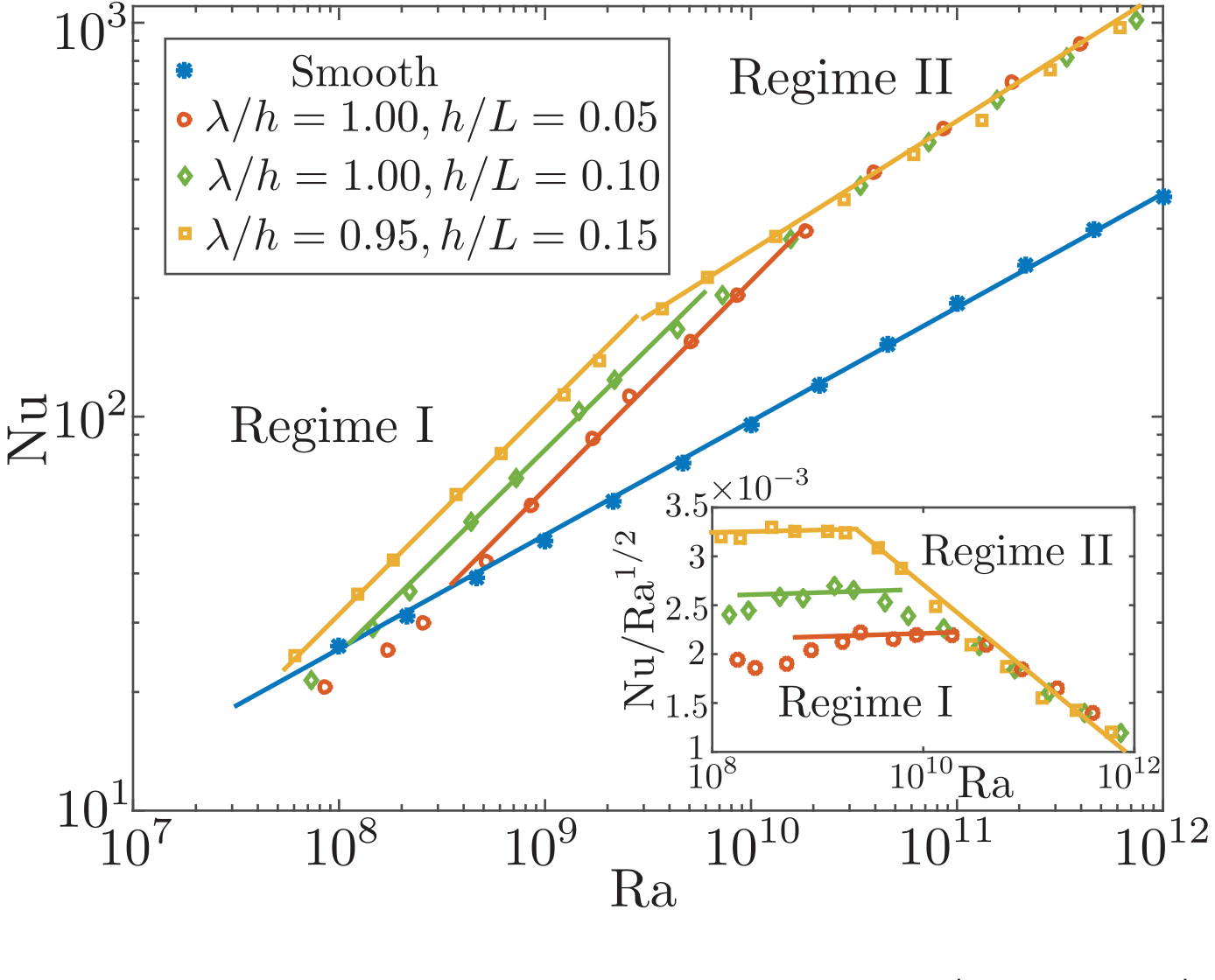
The return from one half to one third provides strong bounded evidence that a finite local one-half exponent is not sufficient to identify the ultimate regime. The bulk/boundary-layer sequence is a physically supported interpretation, not a causally isolated universal mechanism.
Why this matters
The same apparent one-half law can arise temporarily from roughness and then disappear.
Research context
The simulated sequence moves from plume-mediated, bulk-dominated transport to thin thermal layers coating the rough surface at higher Rayleigh number. The accompanying Taylor–Couette comparison is contextual and does not transfer that Rayleigh–Bénard mechanism automatically.
View in the complete publication list Related thermal convection research