Publication 55 · Thermal convection
Sharp transitions in rotating turbulent convection
K.M.J. Alards, R.P.J. Kunnen, R.J.A.M. Stevens, D. Lohse, F. Toschi, H.J.H. Clercx, Phys. Rev. Fluids 4, 074601 (2019).
Read the article Open-access version
Main finding
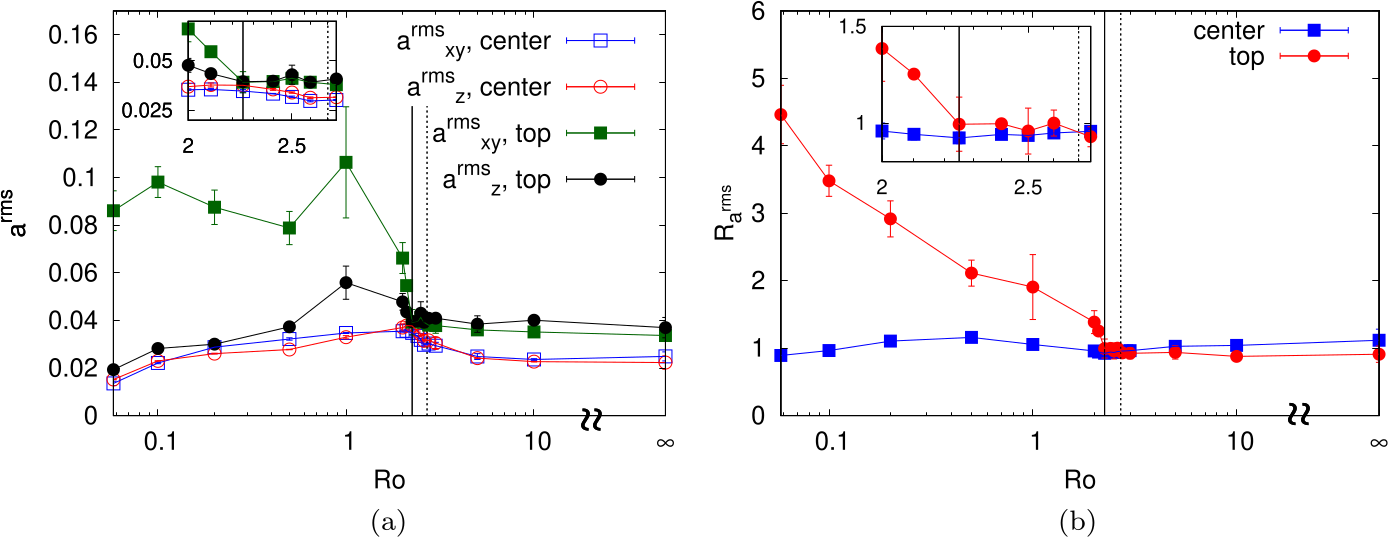
Two distinct response thresholds appear in the chosen case: heat transport near Ro(c1) ≈ 2.7 and Lagrangian acceleration/plume statistics near Ro(c2) ≈ 2.25. The authors interpret Ro(c2) as mature cyclonic Ekman plumes emerging from the boundary layer and entering the bulk, producing extreme horizontal accelerations.
Why this matters
Heat transfer and Lagrangian plume statistics need not respond at the same rotation threshold, so a single transition marker is insufficient.
Research context
The local Lagrangian statistics separate the heat-transport threshold from a second threshold associated with mature cyclonic Ekman plumes entering the bulk. Both thresholds come from one Rayleigh- and Prandtl-number case and require broader rotating-regime comparison before generalization.
View in the complete publication list Related thermal convection research