Publication 102 · Atmospheric turbulence
Vertical structure of conventionally neutral atmospheric boundary layers
L. Liu, R.J.A.M. Stevens, Proc. Natl Acad. Sci. USA 119 (22), e2119369119 (2022).
Read the article Open-access version (arXiv manuscript)
Main finding
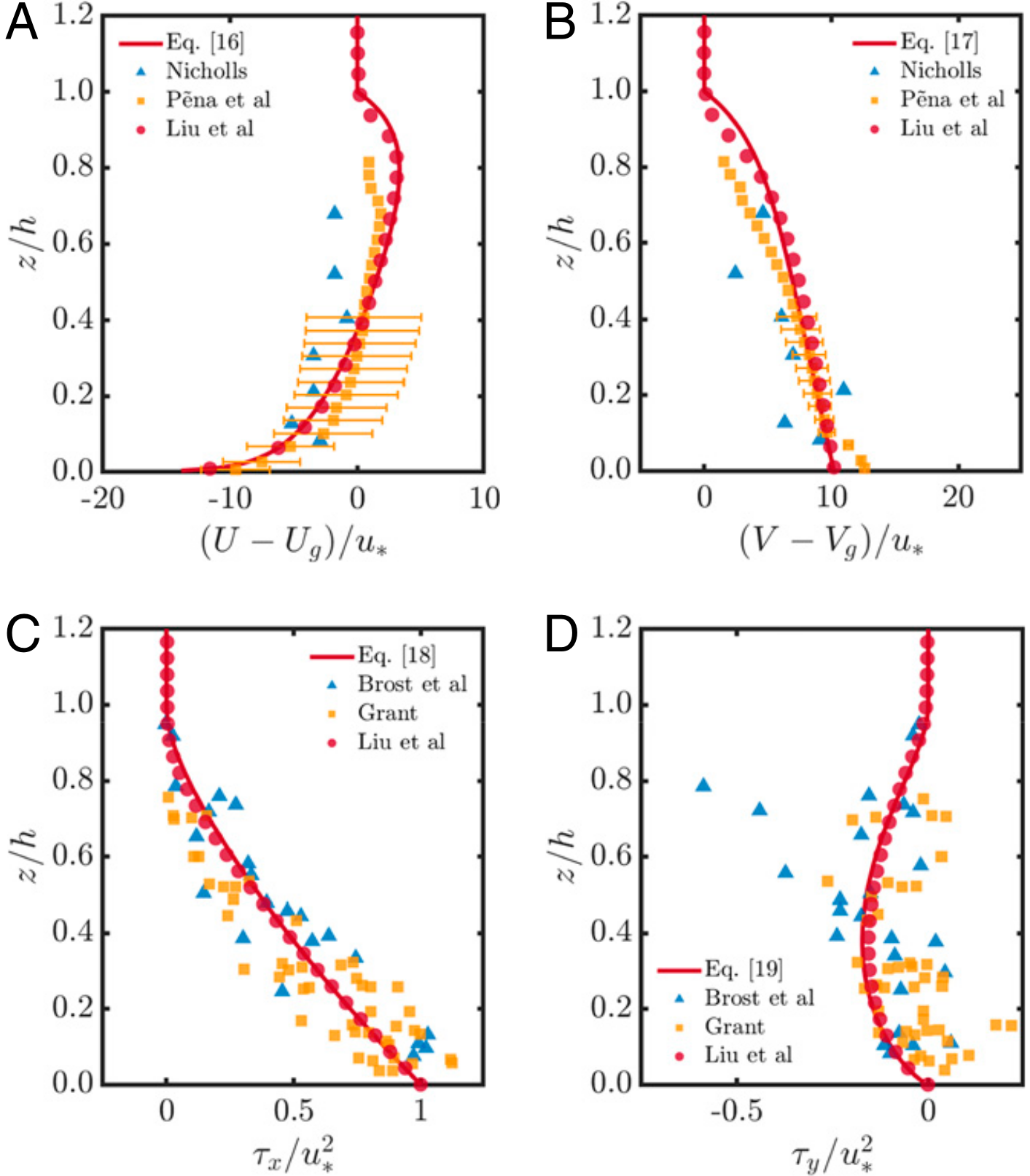
An analytical component-profile model connects rotation and capping-inversion effects to wind turning and stresses in conventionally neutral boundary layers. It agrees visually with inherited LES and selected field profiles within a declared asymptotic error, but is not an independent replication, unique first-principles closure or universal atmospheric profile.
Why this matters
Rotation and the stable cap turn wind with height even when surface heat flux is nearly zero.
Research context
Geostrophic drag law for conventionally neutral atmospheric boundary layers… (read the finding) supplies the height and GDL parameterizations, Figure 2 points, and Figure 5 simulation circles. Universal Wind Profile for Conventionally Neutral Atmospheric Boundary Layers (read the finding) supplies the universal heat-flux basis, epsilon=0.12, and all six LES cases used in Figures 3–4. These dependencies are explicit in the PNAS text.
View in the complete publication list Related atmospheric boundary layer research