Publication 63 · Thermal convection
From zonal flow to convection rolls in Rayleigh-Bénard convection with free-slip plates
Q. Wang, K.L. Chong, R.J.A.M. Stevens, R. Verzicco, D. Lohse, J. Fluid Mech. 905, A21 (2020).
Read the article Open-access version
Main finding
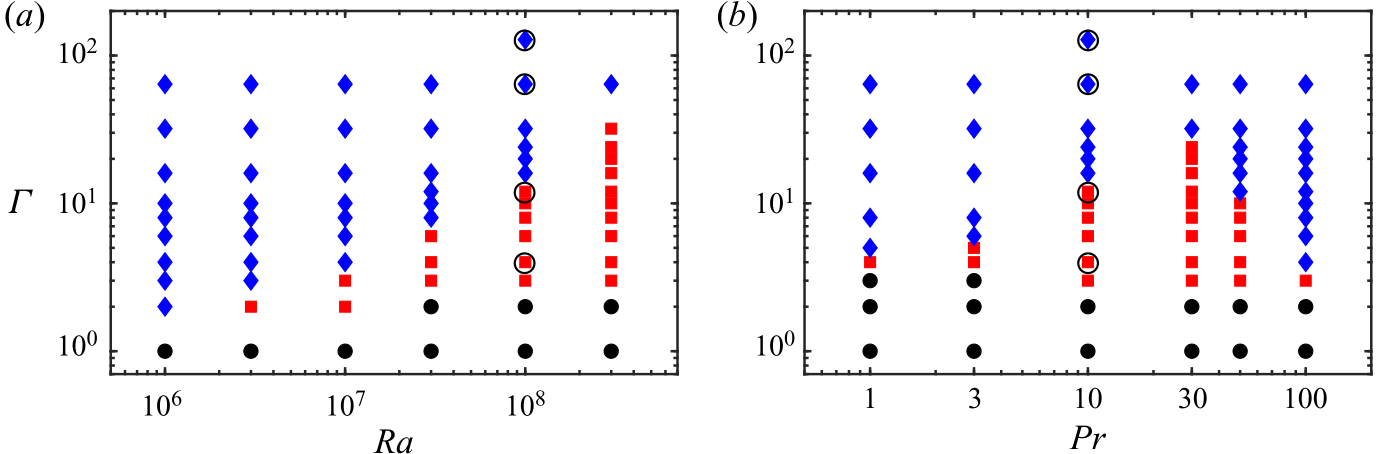
Periodic free-slip boundaries permit unsheared horizontal winds; increasing domain width permits roll nucleation and can eliminate global zonal flow. In spanwise-rotating 3-D flow, stronger rotation makes global response and organization more 2-D-like. At 1/Ro=3.75, Γ=8 supports both zonal and roll states, while all tested Γ=16 initial conditions reach rolls.
Why this matters
Boundary conditions and domain size can select different flow organizations and heat-transport branches.
Research context
Free-slip periodic plates permit unsheared horizontal winds, while a wider domain permits roll nucleation. The branch selected in the simulations depends on domain width, rotation, and initial state, in contrast to the no-slip superstructures studied elsewhere.
View in the complete publication list Related thermal convection research