Sheared convection
Using direct numerical simulations (DNS), we study how imposed shear reorganizes convection and changes heat and momentum transport.
Heat and momentum transport: the 2024 scaling result
Across the tested Couette- and Poiseuille-forced DNS, ReS/ReR organized a common non-monotonic response: moderate shear reoriented and swept thermal plumes, lowering Nu by 18%–26% at the sampled minima, whereas stronger shear produced recovery or enhancement and a friction response consistent with Prandtl's logarithmic law.
Studied scope: Horizontally periodic, smooth-wall DNS, tested mainly over 106 ≤ Ra ≤ 108, 0.5 ≤ Pr ≤ 5, and 0 ≤ ReS ≤ 104. The normalized relations require unsheared reference values and have not been validated outside the sampled parameter range.
Shear, buoyancy and flow organization
Rayleigh-Bénard convection and wall-bounded shear flow are both canonical, extensively studied turbulence problems on their own. Sheared thermal convection combines them: a mean shear, generated by moving the top and bottom plates relative to each other (plane Couette-type forcing) or by an imposed large-scale wind, is superimposed on the buoyancy-driven convective flow. This coupling of shear and buoyancy is directly relevant to the atmospheric boundary layer, where wind shear and surface heating or cooling act together, so sheared convection serves as an idealized, numerically and experimentally tractable model for that interaction.

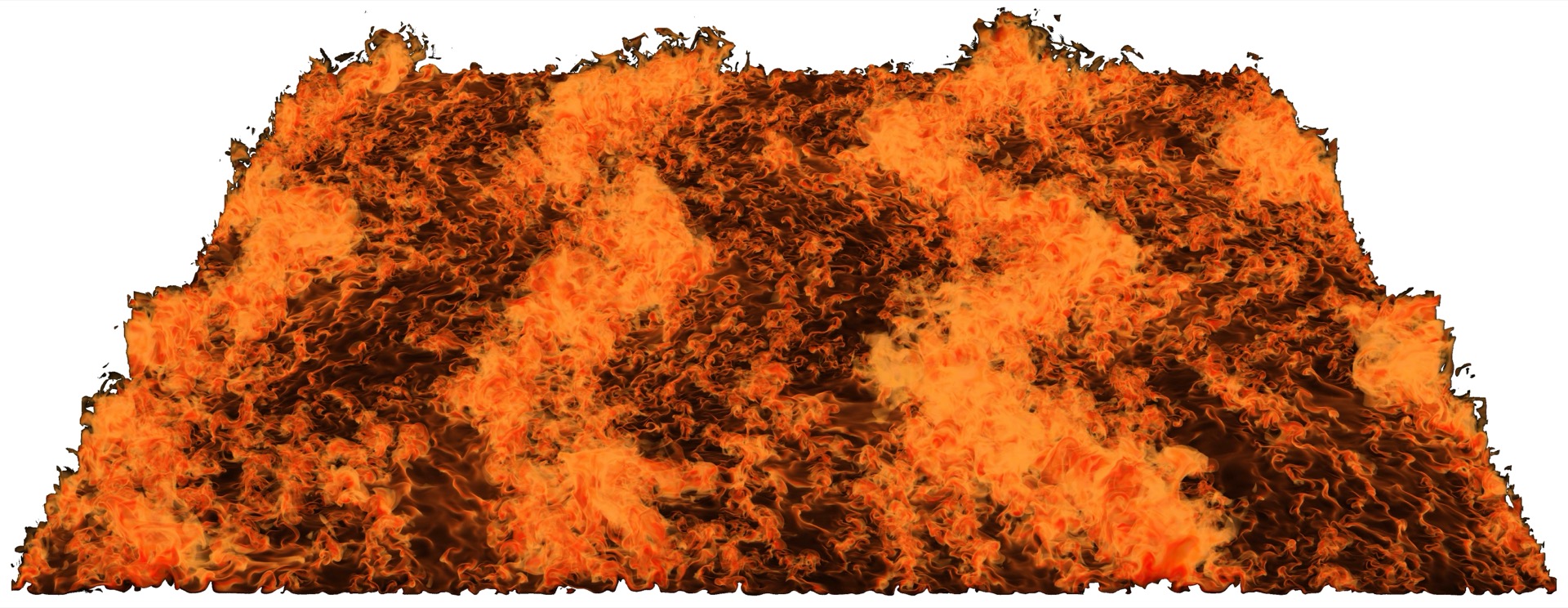
Using direct numerical simulations, we have studied how increasing shear reorganizes the convective flow and changes the efficiency of heat and momentum transport [1]. As the shear strength grows relative to the buoyancy forcing, the large-scale convection rolls that dominate unsheared Rayleigh-Bénard convection are progressively broken down and replaced by more streak-like, shear-aligned structures, with a corresponding change in how heat is carried between the plates. We subsequently examined how this shear-buoyancy interplay depends on the Prandtl number [2], and how small-scale flow structures — not just the large-scale flow organization — contribute to the heat transport in sheared convection [3].
Bringing these results together, we derived normalized scaling relations for heat transport and wall friction in sheared Rayleigh-Bénard convection [4]. The ratio of imposed-shear strength to the unsheared convection-wind strength organizes the crossover from buoyancy-dominated to shear-dominated response in the tested DNS.
Passive-scalar reference
Passive-scalar transport in smooth turbulent Couette flow followed Nu ≈ 0.015 Pr^(1/2) Re_b^(3/4) over the tested intermediate range. The scaling is consistent with a Reynolds-analogy link between scalar flux and wall stress, not a universal high-Reynolds-number asymptote.
See the scaling figure and evidence boundaries. This passive-scalar Couette result isolates the shear-driven reference problem; it does not include the buoyancy coupling studied on this page.
References
-
G.S. Yerragolam, C.J. Howland, R.J.A.M. Stevens, R. Verzicco, O. Shishkina, D. Lohse,
Scaling relations for heat and momentum transport in sheared Rayleigh-Bénard convection,
J. Fluid Mech. 1000, A74 (2024). Read the finding -
G.S. Yerragolam, R. Verzicco, D. Lohse, R.J.A.M. Stevens,
How small-scale flow structures affect the heat transport in sheared thermal convection,
J. Fluid Mech. 944, A1 (2022). Read the finding -
A. Blass, P. Tabak, R. Verzicco, R.J.A.M. Stevens, D. Lohse,
The effect of Prandtl number on turbulent sheared thermal convection,
J. Fluid Mech. 910, A37 (2021). Read the finding -
A. Blass, X. Zhu, R. Verzicco, D. Lohse, R.J.A.M. Stevens,
Flow organization and heat transfer in turbulent wall sheared thermal convection,
J. Fluid Mech. 897, A22 (2020). Read the finding