Publication 123 · Wind-energy acoustics
How wind-farm layout changes modeled noise
J. Colas, A. Emmanuelli, D. Dragna, and R.J.A.M. Stevens, Renewable Energy 273, 126052 (2026).
Read the article Open-access version
The article and Figure 14 are open access under CC BY 4.0.
Main finding
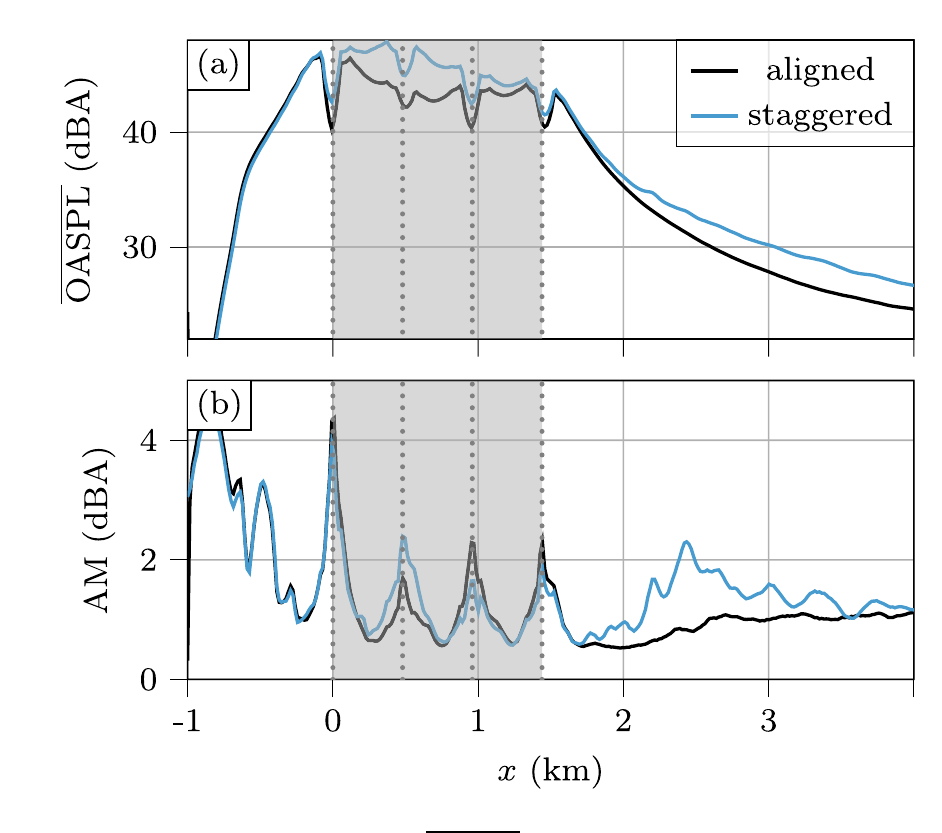
In one modeled stable-atmosphere case, a staggered 4 × 4 wind farm produced spatially averaged downwind sound levels about 3 dBA higher than the aligned layout beyond 2 km. The coupled calculation attributes the difference to both layout-dependent turbine source emission and sound propagation through the wind-farm flow.
Why this matters
Wind-farm noise is not obtained by multiplying an isolated-turbine prediction. Layout changes the wake velocity and turbulence encountered by each rotor, which changes the modeled source emission. The combined wind-farm wake also changes atmospheric refraction and focusing between the turbines and receivers. Both parts of the source-to-receiver chain therefore have to be represented when layouts are compared.
Research context
The comparison couples actuator-disk large-eddy simulation, turbulent-inflow and trailing-edge source models, and wide-angle N × 2D parabolic-equation propagation. It covers aligned and staggered 4 × 4 farms of NREL 5 MW turbines at 4D streamwise and spanwise spacing, one stable atmospheric boundary layer, one ground model, and frequencies from 50 to 1080 Hz. A model-bookkeeping comparison assigns about 1.5 dBA of the downwind layout difference to turbine source powers and the remainder to propagation, but this is not an uncertainty-bounded causal decomposition. The calculation has no fully three-dimensional acoustic benchmark, displayed source-height or angular convergence, flow ensemble, field validation, or human-response evidence. It therefore does not establish a universal staggered-layout penalty, a worst atmospheric condition, or a permitting or annoyance outcome.
View in the complete publication list Related research highlights