Publication 21 · Thermal convection
Comparison between two and three dimensional Rayleigh-Bénard convection
E.P. van der Poel, R.J.A.M. Stevens, D. Lohse, J. Fluid Mech. 736, 177-194 (2013).
Read the article Open-access version (arXiv manuscript)
Main finding
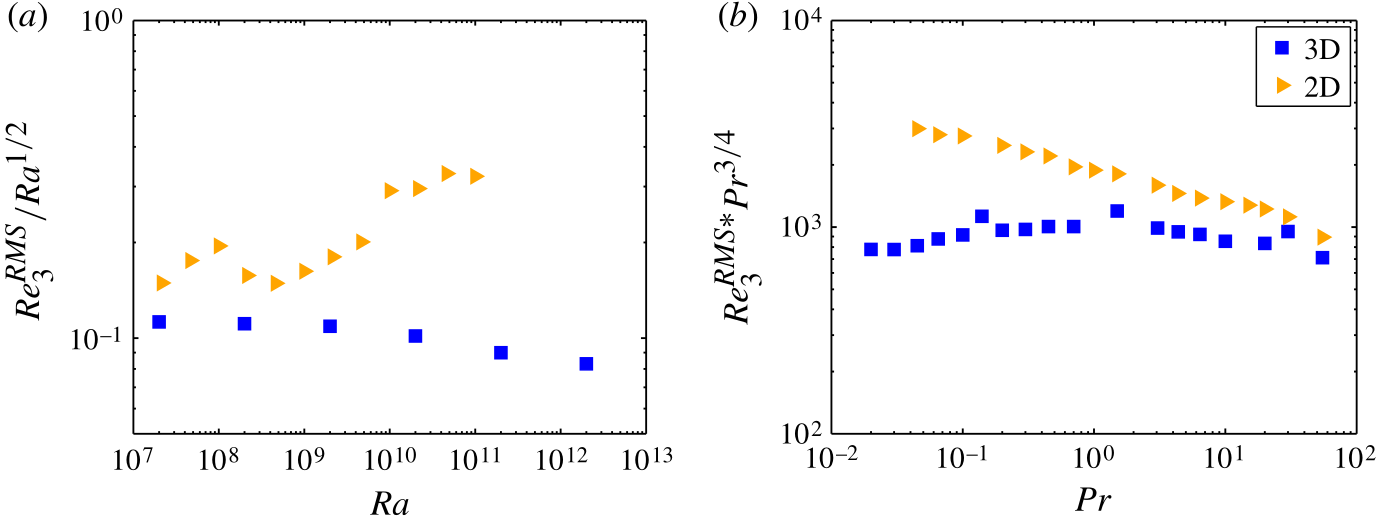
Two-dimensional transfer is regime- and observable-specific; agreement in Nu does not establish equivalence of flow, Reynolds number, or boundary layers.
Why this matters
Similar global heat flux in two- and three-dimensional convection can conceal different flow structures, Reynolds numbers, and boundary layers.
Research context
The comparison spans two-dimensional rectangular and three-dimensional cylindrical simulations across different Rayleigh- and Prandtl-number ranges. Agreement is regime- and observable-specific; the constant-factor heat-transfer comparison is empirical.
View in the complete publication list Related thermal convection research