Publication 45 · Thermal convection
Confined Rayleigh-Bénard, Rotating Rayleigh-Bénard, and Double Diffusive Convection
K.L. Chong, Y. Yang, S.-D. Huang, J.-Q. Zhong, R.J.A.M. Stevens, R. Verzicco, D. Lohse, K.-Q. Xia, Phys. Rev. Lett., 119, 064501 (2017).
Read the article Open-access version
Main finding
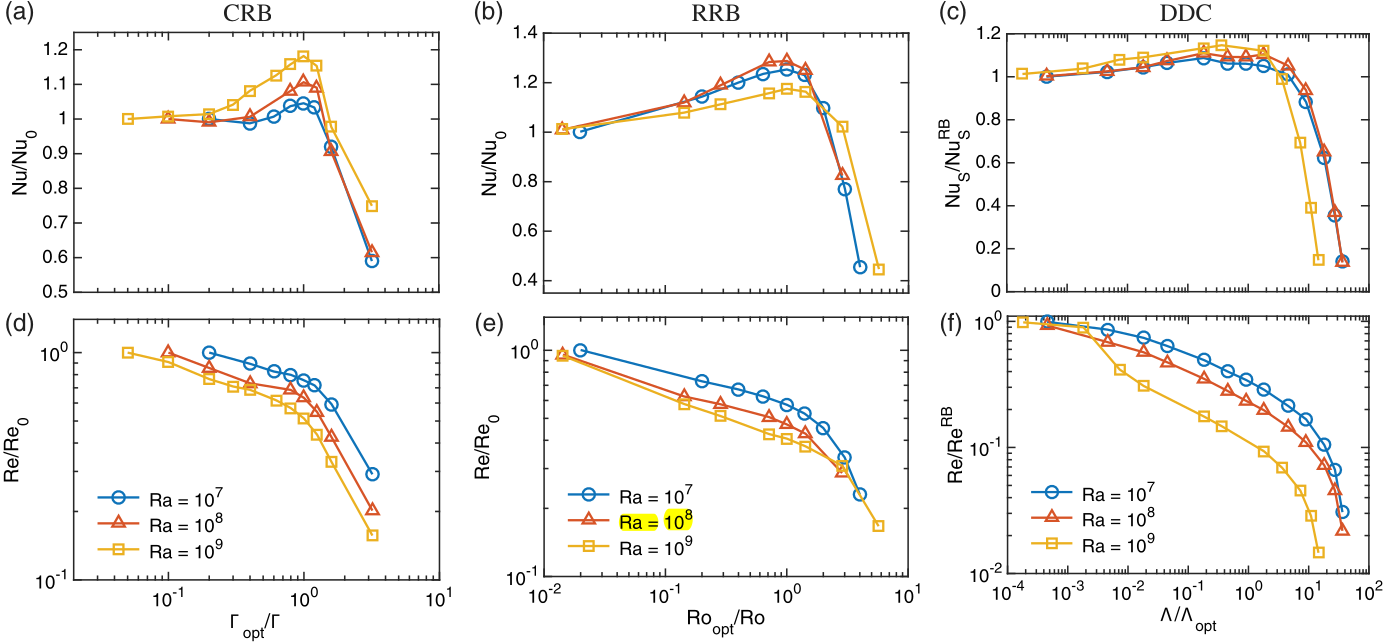
Stabilization first organizes sheet-like emission into fewer, vertically coherent structures, increasing scalar transport efficiency, and later suppresses motion strongly enough that transport falls. The proposed optimum couples strong suction at the momentum-layer edge with large scalar fluctuations; after the layer crossing, suction samples a region with weaker scalar anomaly.
Why this matters
Three different systems display the same bounded phenomenology: moderate stabilization can increase scalar transport even while mass transport weakens.
Research context
The comparison reuses earlier confinement and double-diffusive simulations and connects them to rotating-convection results. Across all three systems, moderate stabilization organizes transport before stronger stabilization suppresses the flow; wall-sheared convection (read the finding) provides a distinct nonmonotonic forcing pathway.
View in the complete publication list Related thermal convection research