Publication 113 · Atmospheric turbulence
Geostrophic Drag Law in Conventionally Neutral Atmospheric Boundary Layer
L. Liu, X. Lu, R.J.A.M. Stevens, Boundary-Layer Meteorol 190, 37 (2024).
Read the article Open-access version (university repository)
Main finding
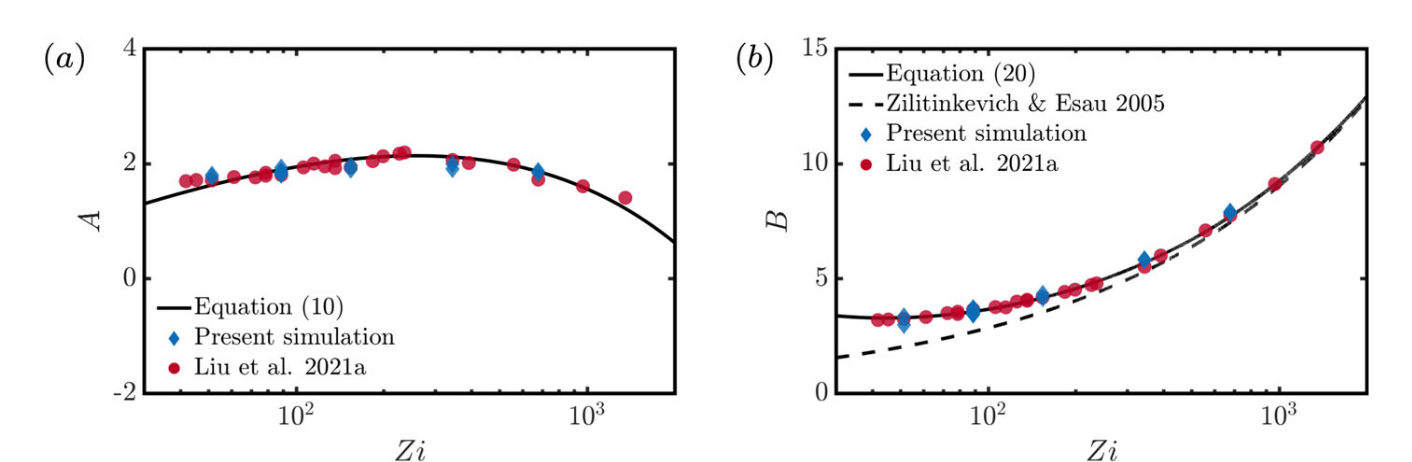
A four-constant geostrophic drag law simplifies the relation between surface drag, rotation and the stable cap in the tested conventionally neutral boundary layers. Its test remains within the same LES code family and assumes high Zi; the reported domain/damping inconsistency and uncertainty limits remain unresolved.
Why this matters
Rotation, surface drag, and the stable cap jointly control the wind/pressure mismatch.
Research context
Geostrophic drag law for conventionally neutral atmospheric boundary layers… (read the finding) supplies the calibration dataset, code lineage, and earlier GDL coefficients. Universal Wind Profile for Conventionally Neutral Atmospheric Boundary Layers (read the finding) supplies additional plotted prior LES points. Vertical structure of conventionally neutral atmospheric boundary layers (read the finding) supplies analytical support for the streamwise normalized-gradient assumption. These reused inputs are dependencies rather than independent validation.
View in the complete publication list Related atmospheric boundary layer research