Publication 129 · Clouds and atmospheric flow
Low-level cloud radiative forcing enhances wind-farm wake recovery
D. Selvatici, R.J.A.M. Stevens, PRX Energy 5, 033014 (2026).
Main finding
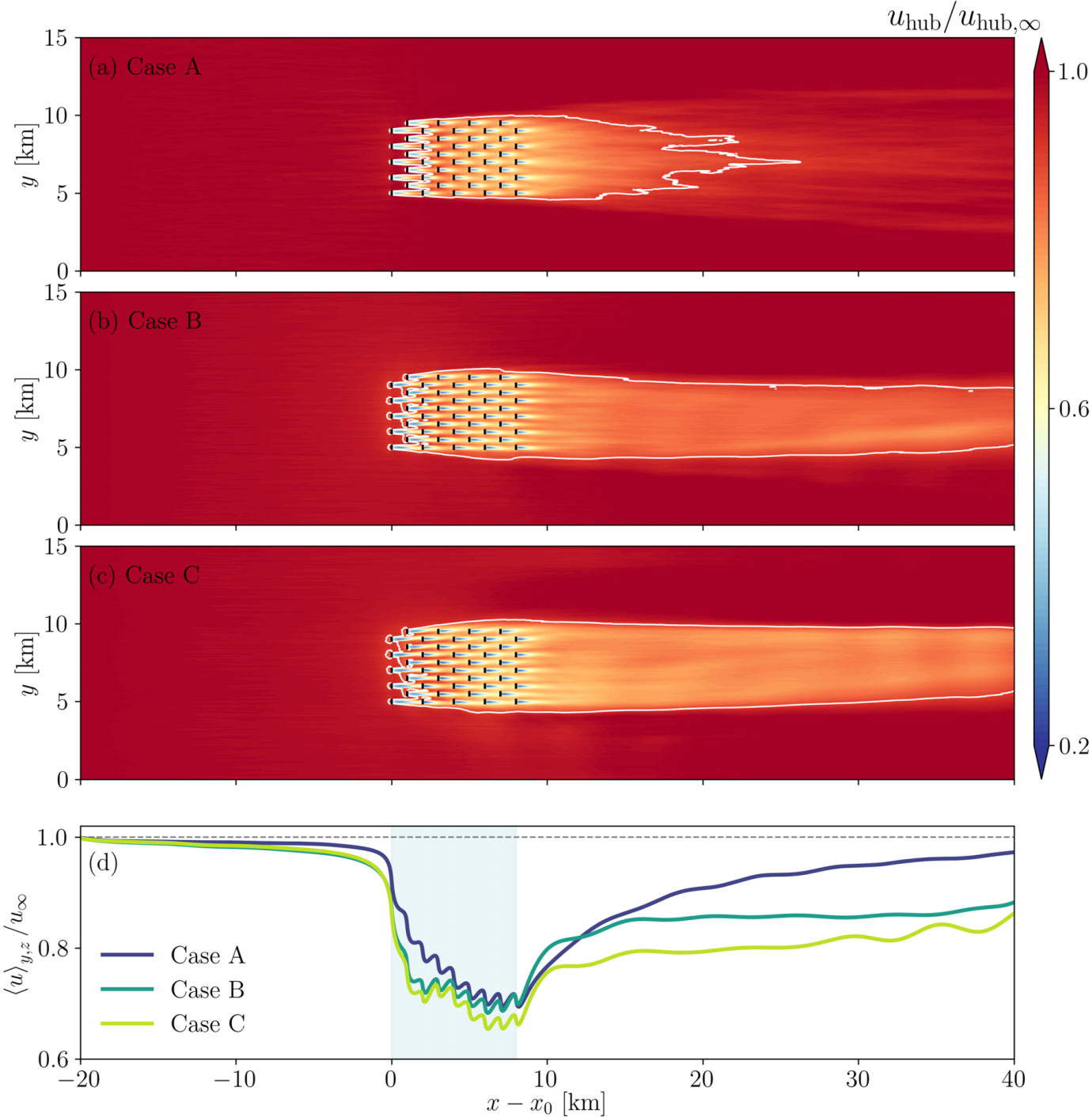
Cloud-top radiative cooling can shorten the far wake of a wind farm by strengthening mixing and downward momentum transport in simulated stratocumulus-topped boundary layers (STBL). The conditional large-eddy simulation (LES) result does not establish a universal cloud benefit or quantified operational gain.
Why this matters
Cloud-top cooling can deepen atmospheric mixing and shorten a farm wake.
Research context
The study draws on research into atmospheric stability and wind-farm coupling (Impact of Negative Geostrophic Wind Shear on Wind Farm… (read the finding), Effects of wind turbine rotor tilt on large-scale wind… (read the finding), Diurnal surface heat-flux forcing controls wind-farm performance, blockage, and… (read the finding)), wake recovery and mechanical-energy transport (From turbine-scale to wind farm-scale wake recovery (read the finding)), and finite-farm atmospheric interactions.
Related findings: From turbine-scale to wind farm-scale wake recovery: Understanding the transition; Diurnal surface heat-flux forcing controls wind-farm performance, blockage, and gravity-wave formation.
Coverage of this research
- APS Physics — The Effect of Clouds on Wind Farms, . Synopsis of the Selvatici–Stevens study of cloud-driven mixing and wind-farm wake recovery.
- University of Twente — Cloud cover helps offshore wind farms, . University research news about the Selvatici–Stevens cloud and wind-farm wake simulations, with the need for field confirmation.
- scinexx — Wolken können den Windschatten von Offshore-Windparks abschwächen, . German-language coverage of the same cloud and wind-farm wake simulations, citing the study, University of Twente report and APS synopsis.
- Knowridge — Clouds Could Help Offshore Wind Farms Produce More Power, . Science coverage of the same cloud and wind-farm wake study; an operational power benefit remains unconfirmed.
- Sustainable Stories Africa — New Simulations Show Low-Level Clouds Help Offshore Wind Farm Wakes Recover Faster, . Secondary coverage of the same simulation study, distinguishing the wake-recovery mechanism from a field-tested design rule.