Richard J.A.M. Stevens

Physics of Fluids · University of Twente

Publication 15 · Thermal convection

Prandtl and Rayleigh number dependence of heat transport in high Rayleigh number thermal convection

R.J.A.M. Stevens, D. Lohse, R. Verzicco, J. Fluid Mech. 688, 31-43 (2011).

Main finding

Prandtl–Blasius-type boundary-layer thickness scaling persists through Ra = 2 × 10¹² in these simulations.
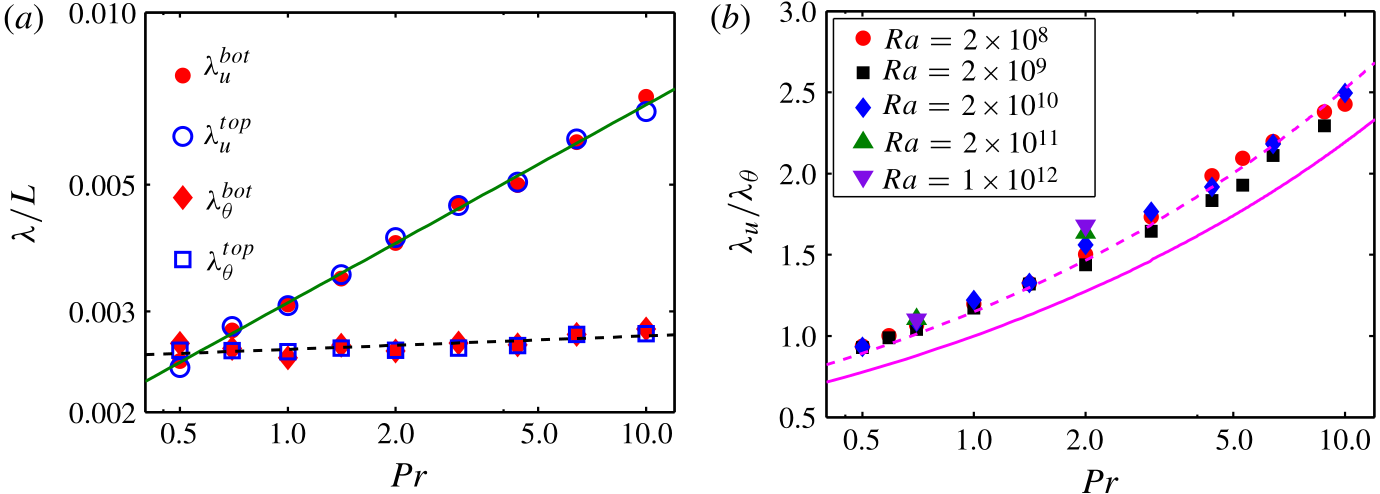
Kinetic and thermal boundary layer thicknesses and their ratio against Prandtl number
How to read the figure. Kinetic and thermal boundary layer thicknesses against Prandtl number at both plates (a), and their ratio across Rayleigh numbers from 2 x 10^8 to 10^12 against the Prandtl-Blasius prediction (b). The measured ratio follows the laminar prediction over the whole range, so Prandtl-Blasius-type thickness scaling survives well into the high-Rayleigh-number regime. Open the full-resolution figure. Figure 7. R.J.A.M. Stevens et al. (2011). No separate licence is stated here; consult the original publication and credited source before reuse.

Why this matters

The high-Rayleigh-number DNS provides useful negative tests of proposed explanations for divergent heat-transfer branches and a bounded test of boundary-layer scaling.

Research context

The paper provides high-Ra evidence later used in The unifying theory of scaling in thermal convection; it should remain distinct from the GL refit and from experimental branches. General/Bachelor value is limited; Master through Expert value is high for negative tests, numerical-resolution caution, and regime-bounded boundary-layer evidence.

Read the article View in the complete publication list Related thermal convection research