Publication 64 · Thermal convection
From Rayleigh-Bénard convection to porous-media convection
S. Liu, L. Jiang, K.L. Chong, X. Zhu, Z.-H. Wan, R. Verzicco, R.J.A.M. Stevens, D. Lohse, C. Sun, J. Fluid Mech. 895, A18 (2020).
Read the article Open-access version (university repository)
Main finding
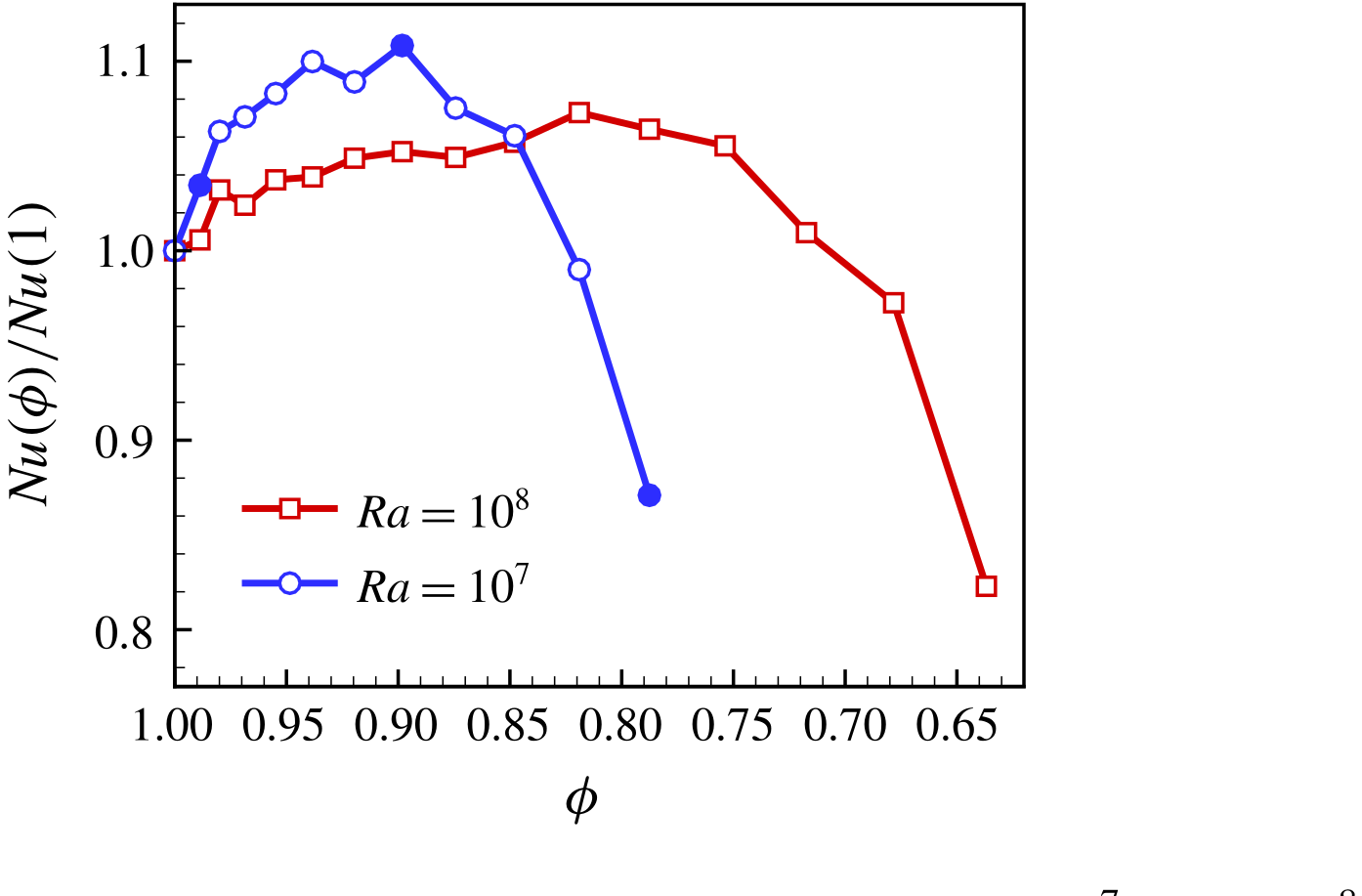
Moderate obstruction organizes convection and enhances heat transport before stronger blockage suppresses the flow in the simulated system. Transfer of the observed length-scale crossover to Darcy flow or three-dimensional systems remains a hypothesis.
Why this matters
A moderate obstruction can organize transport before stronger blockage suppresses it.
Research context
Obstacles initially regularize temperature–velocity coupling and suppress counter-gradient transport, but their drag suppresses the flow at lower porosity. The crossover depends on the pore scale relative to the thermal boundary layer and is demonstrated only in the two-dimensional obstacle geometry studied here.
View in the complete publication list Related thermal convection research